There's a battery in your phone, maybe one in your car, and maybe one on the wall of your garage. They're all "lithium batteries", but they're not the same battery, and they're not looked after the same way. Every few months, a headline also promises that the next battery will change everything.
So do you need to understand battery chemistry before buying solar storage or an electric car? A little. Do you need to wait for the next breakthrough? No. Here's why, in the video and then in writing, with the sources.
The short version
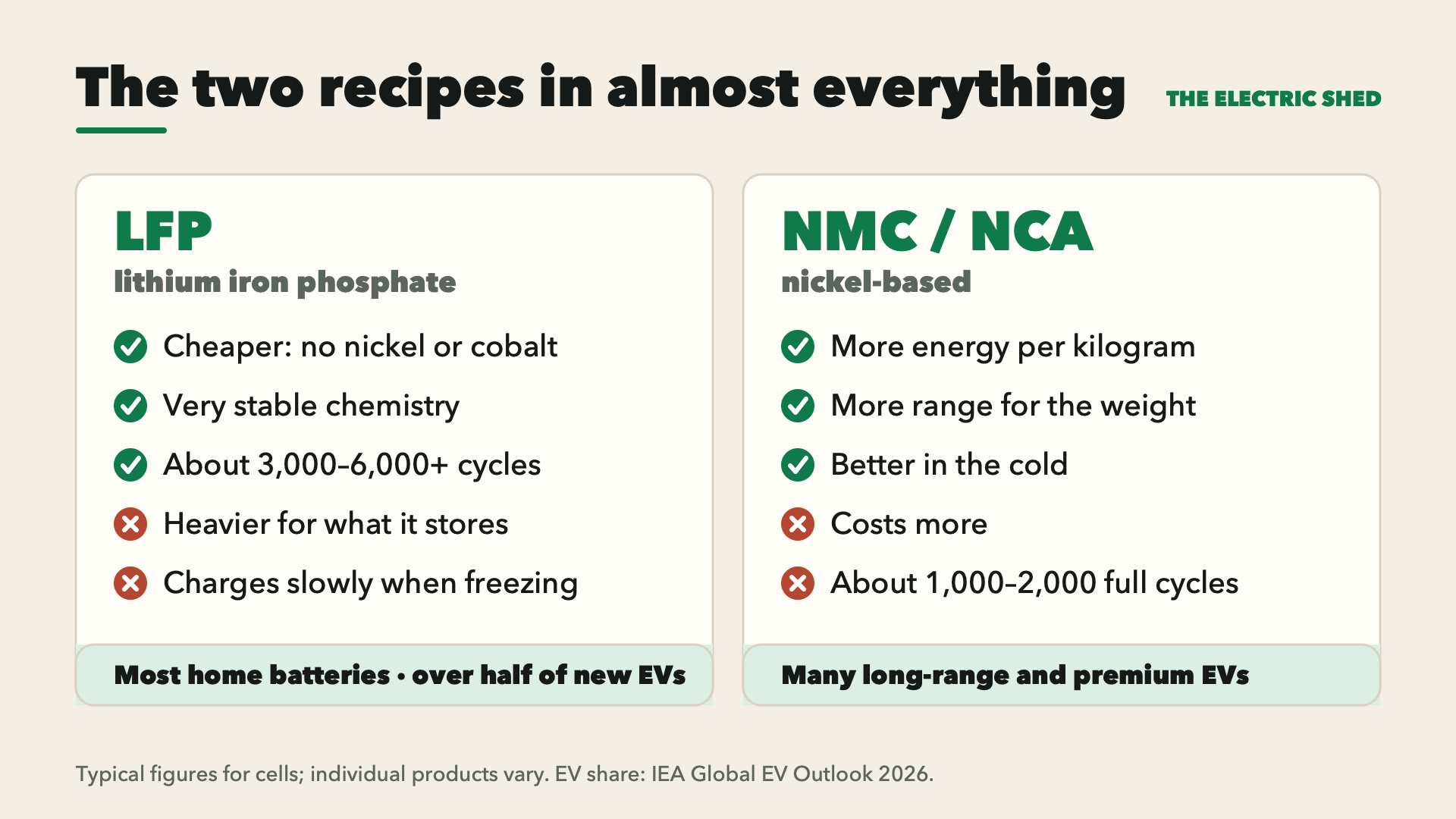
- Almost every home battery and EV uses one of two lithium recipes: LFP (lithium iron phosphate) or a nickel-based one (NMC or NCA).
- Neither is simply "better". A weakness in a car can be irrelevant on a garage wall, and the other way round.
- They last well. Real-world data from more than 22,000 EVs shows an average loss of about 2.3% of capacity a year. Home batteries in a German field study lost roughly 2–3% a year.
- Your car and home battery are managed far more carefully than your phone's.
- Better batteries will always be coming. That isn't a reason to put off a good decision now.
The two recipes in almost everything
LFP: lithium iron phosphate
LFP uses iron and phosphate instead of nickel and cobalt. That makes it:
- cheaper, because it avoids the expensive metals;
- very stable, with a much lower risk of overheating;
- long-lasting, typically rated for 3,000–6,000 or more full charge cycles.
Its main weakness is weight. LFP cells store less energy per kilogram, roughly 160–200 watt-hours per kilogram compared with 250–300 for nickel-based cells. It also charges more slowly when it's below freezing.
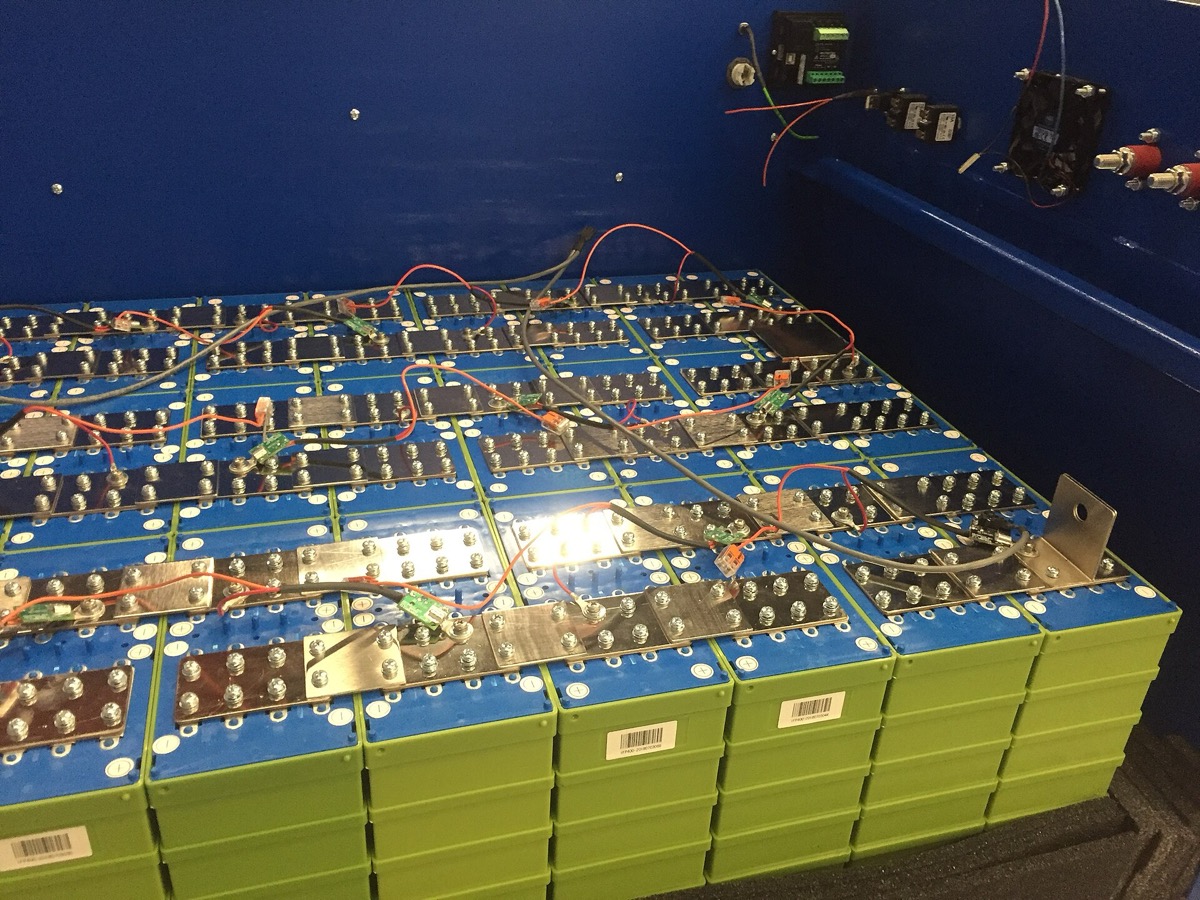
LFP is now the default in home batteries, and according to the IEA's Global EV Outlook 2026, it was in more than 55% of the EV batteries deployed worldwide in 2025. The battery in the house behind this channel is a Sigenergy, and it's LFP.
NMC and NCA: nickel-based
NMC (nickel manganese cobalt) and NCA (nickel cobalt aluminium) pack more energy into the same weight, which is why they've powered most long-range and premium EVs. In exchange, they cost more, are typically rated for fewer full cycles (often 1,000–2,000), and need more careful temperature management.
Cell shape isn't chemistry
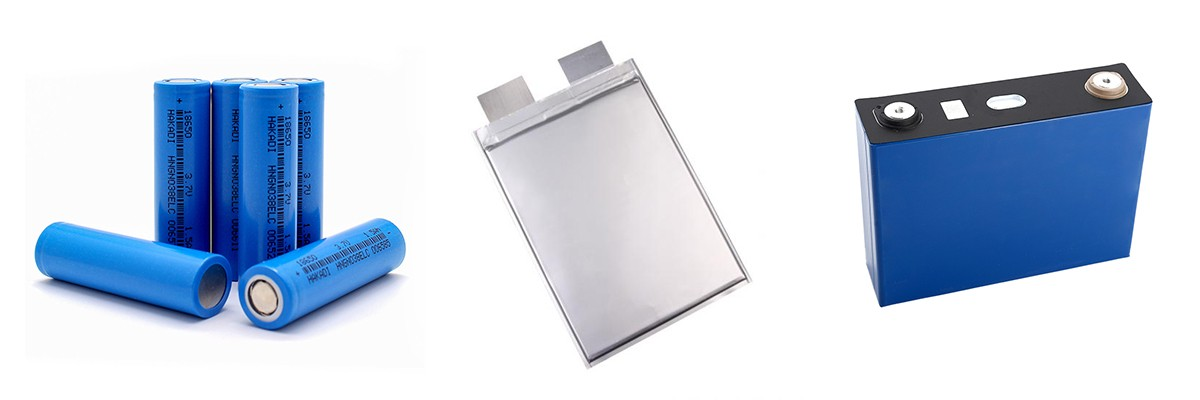
You'll see batteries built from cylinders, flat pouches or rectangular "prismatic" blocks. That's packaging, not chemistry. Either recipe can come in any of these shapes.
Same trait, different verdict
Most comparisons stop at "pros and cons". The more useful question is: pros and cons where?
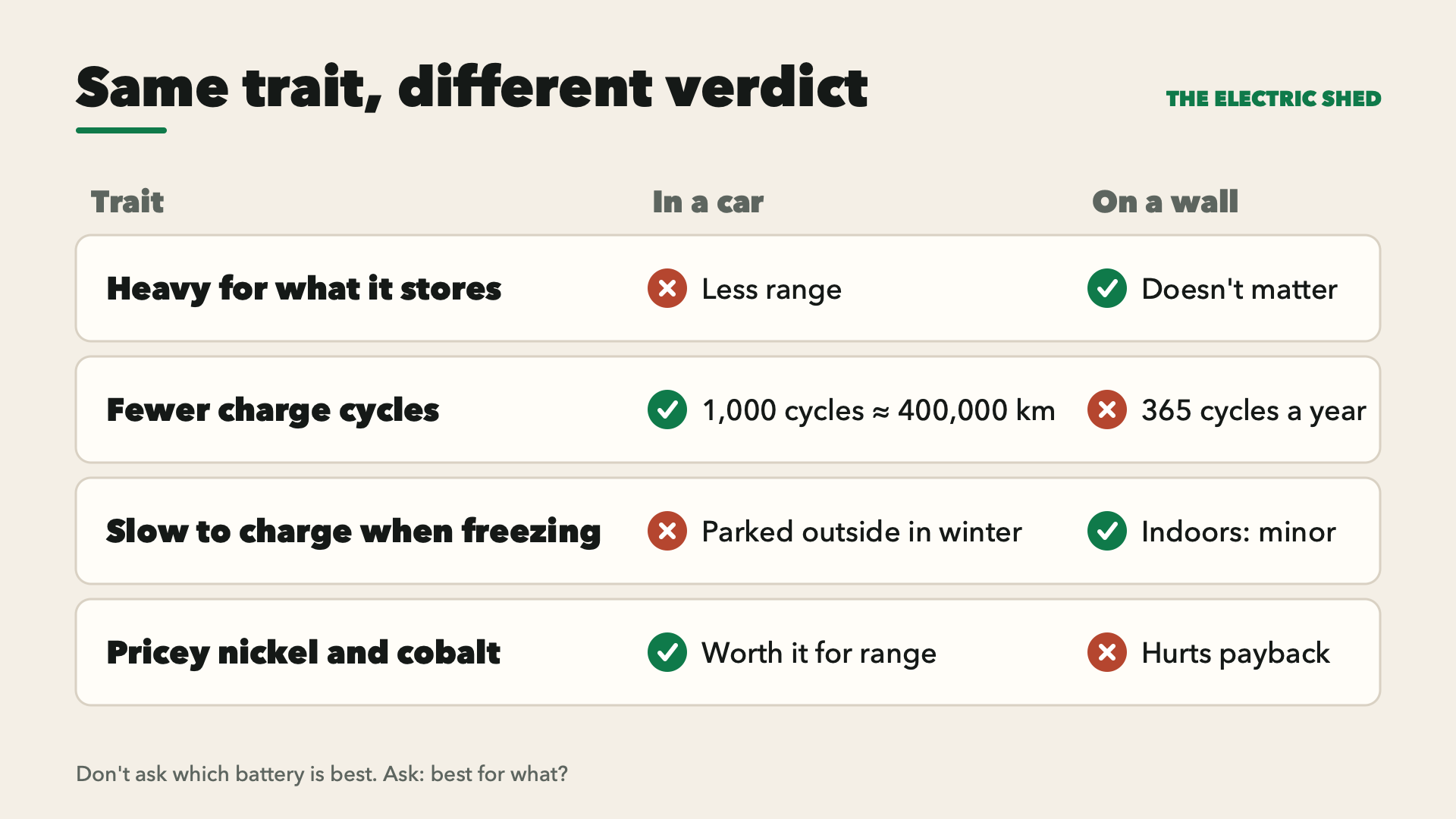
Trait | In a car | On a garage wall |
|---|---|---|
Heavy for what it stores (LFP) | Less range | Doesn't matter |
Fewer charge cycles (NMC) | Fine: 1,000 cycles × 400 km ≈ 400,000 km | Daily cycling adds up: 365 cycles a year |
Slow to charge when freezing (LFP) | A real drawback if parked outside in a cold winter | Minor if it lives in a garage or indoors |
Expensive nickel and cobalt (NMC) | Can be worth it for range | Hurts payback |
The cycle-life row is the one that surprises people. A home battery that charges from solar every day and empties every evening does about 365 cycles a year, so after ten years it's past 3,500. That's where LFP's cycle life earns its keep. A car's battery does far fewer cycles, because each one covers hundreds of kilometres. Even a modest 1,000 cycles at 400 km per charge is 400,000 km, more than most cars ever travel.
Two more you'll hear about
Sodium-ion
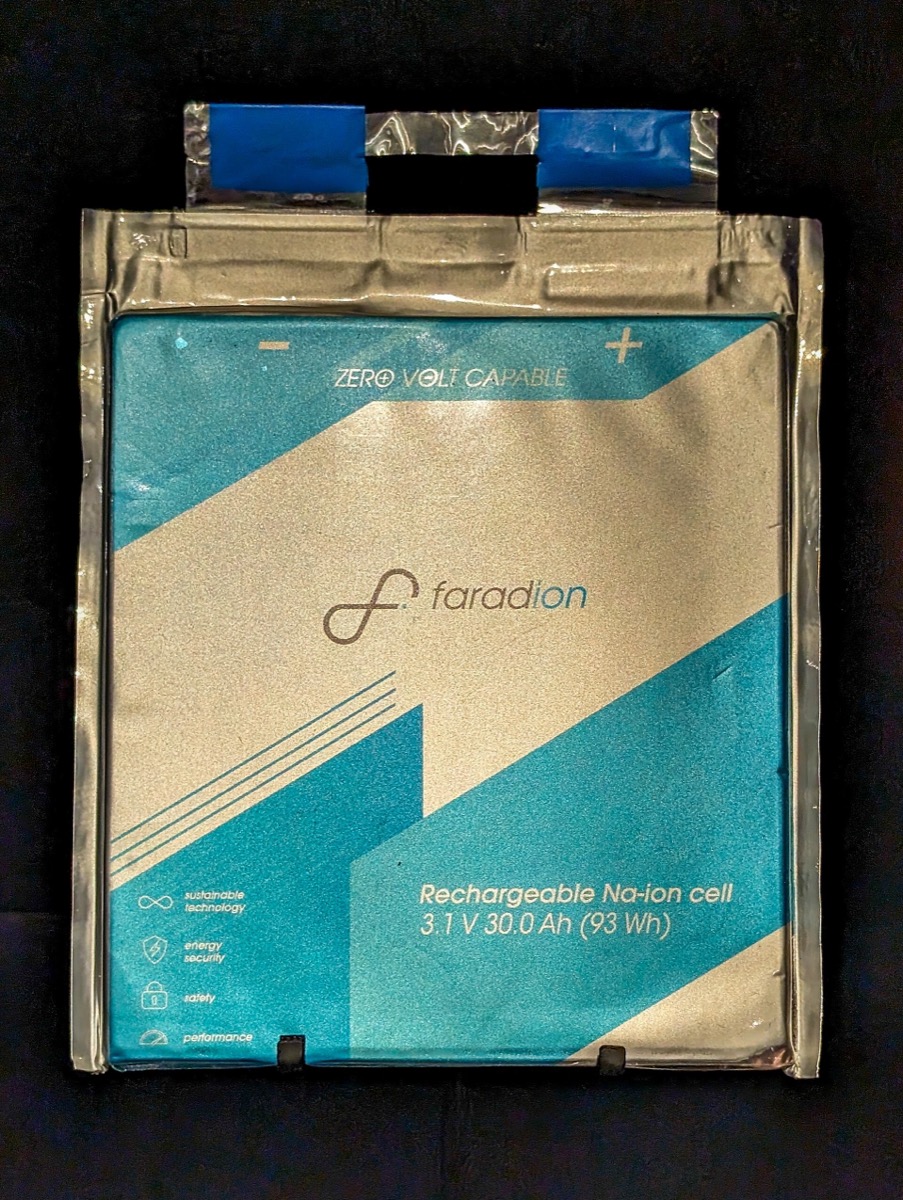
Sodium-ion swaps lithium for sodium, the element in table salt. It's cheaper, works well in the cold, and doesn't depend on lithium supplies. It's heavier for what it stores (CATL's first production cells are rated at about 175 Wh/kg), so it suits home storage and smaller city cars better than long-range ones.
It's no longer a lab curiosity: in 2026, the first production cars with sodium-ion batteries were announced in China, and the first sodium-ion home batteries were installed in Europe. Expect to see it more over the next few years, alongside LFP rather than instead of it.
Lead-acid
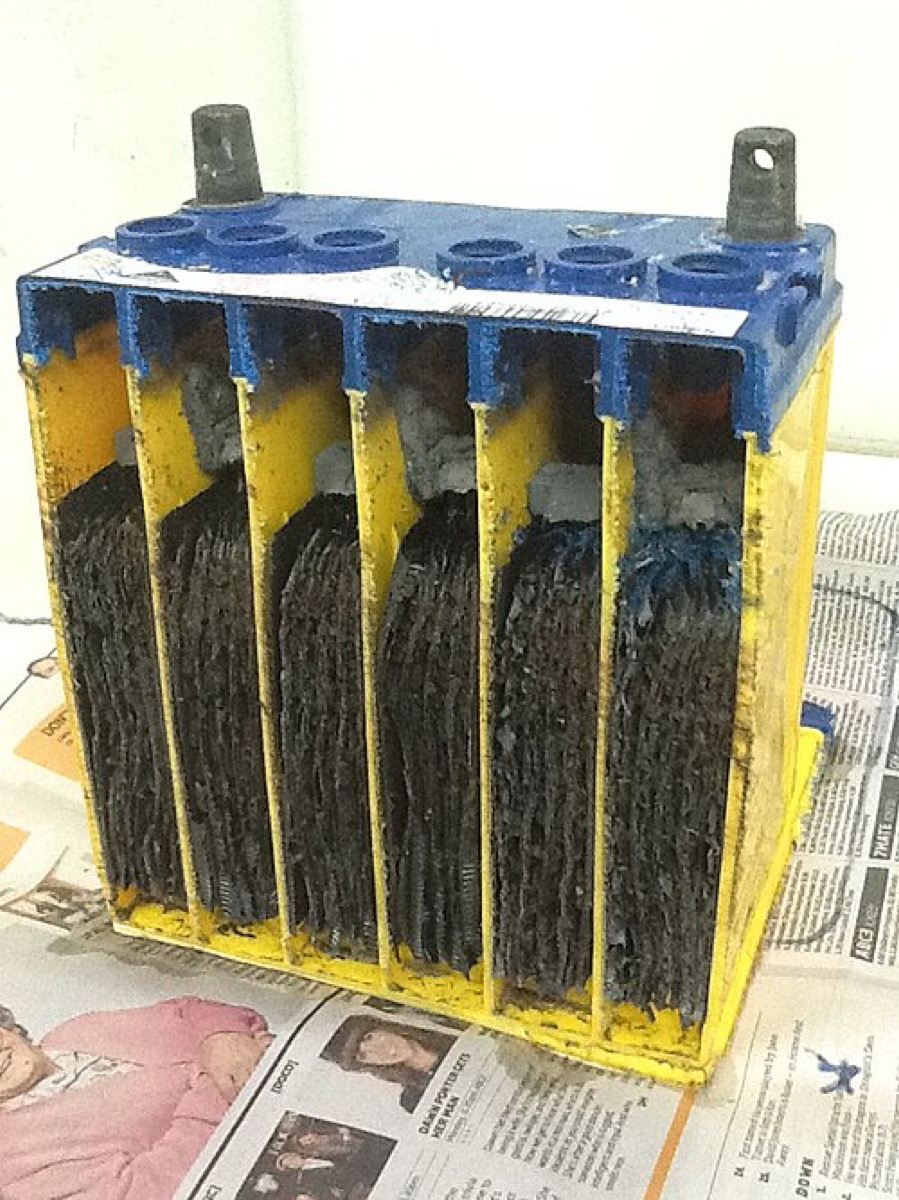
Heavy, short-lived and now mostly gone from home storage. But it's still the small 12-volt battery in a lot of cars, including many EVs, where it runs the lights, locks and computers. For that job, cheap and simple wins.
How long do they really last?
This used to be guesswork. Now there's real-world data.
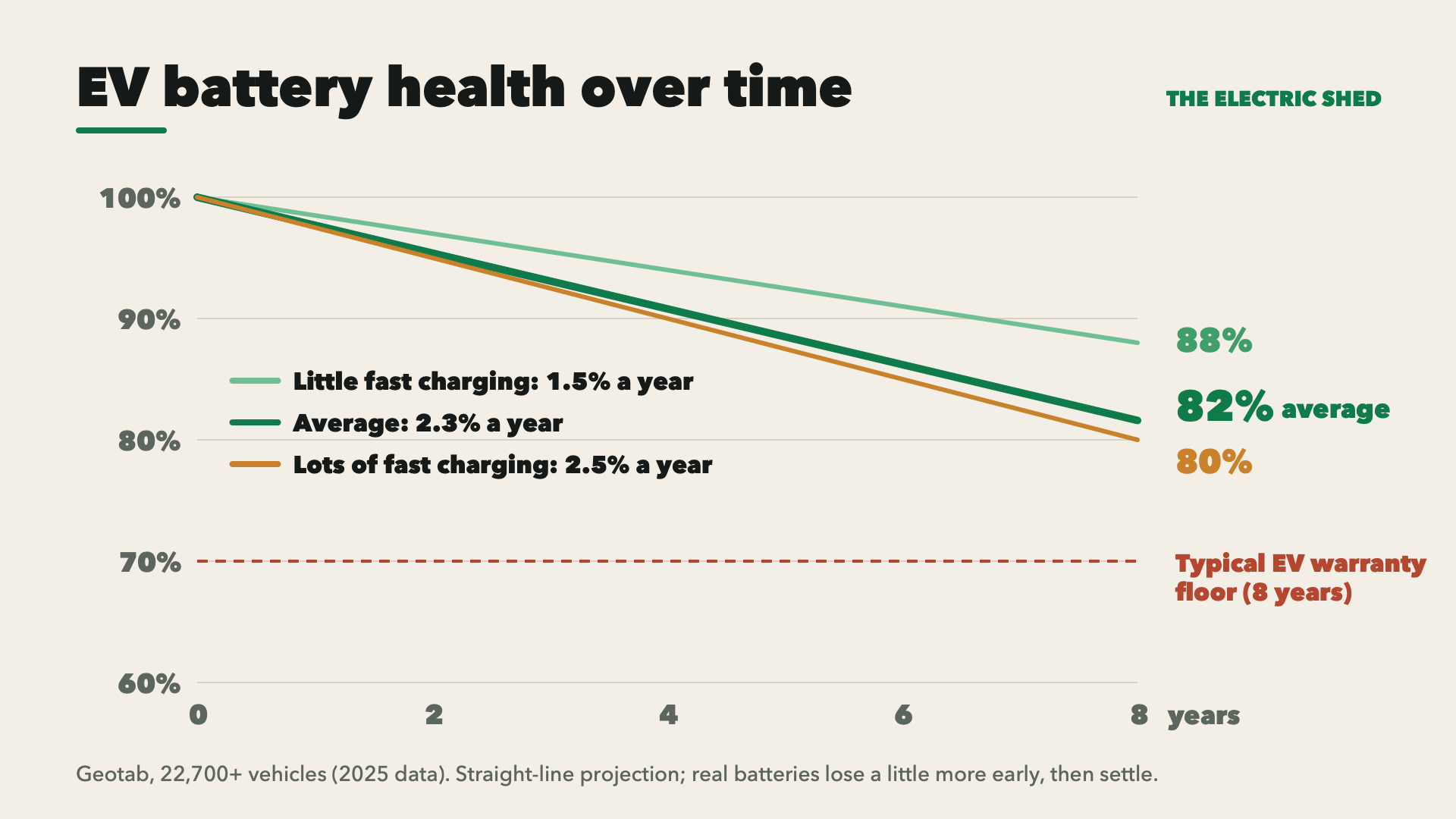
- Electric cars: about 2.3% a year. Geotab, a fleet-telematics company, analysed more than 22,700 EVs in North America and Europe (2025 study, published January 2026). The average battery lost about 2.3% of its capacity a year, which projects to roughly 82% after eight years. Vehicles that used high-power DC fast charging for more than 12% of their charging averaged about 2.5% a year, against about 1.5% for the rest. Hot climates added a few tenths of a per cent a year.
- Real driving is gentler than the lab. A Stanford/SLAC study in Nature Energy (December 2024) tested 92 cells for two years. Realistic driving patterns, with acceleration, braking and rest, gave up to 38% longer life than the constant cycling used in standard lab tests.
- High-mileage cars: Tesla's own figures say its Model S and Model X batteries lose about 12% after 200,000 miles (about 320,000 km). That's the company's data, but it's in line with the independent studies.
- Replacements are rare. Recurrent, which tracks battery health for EV owners, found that outside of recalls, replacements are uncommon and much rarer in newer cars than in the first generation. Early Nissan Leafs, which had no active battery cooling, are the usual cautionary tale.
- Home batteries: roughly 2–3% a year. A German study in Nature Energy (2024) measured 21 privately owned home storage systems for up to eight years, and found capacity falling by about 2–3 percentage points a year. Most home batteries come with a 10-year warranty, typically guaranteeing 60–70% of capacity at the end (see the payback maths).
Batteries also tend to lose a little more in the first year or two, then settle into a slower decline. So a straight-line projection is a reasonable rule of thumb, not a precise forecast.
Why your car battery isn't your phone battery
If your phone is struggling after a couple of years, it's natural to worry about a car or home battery. But the phone has the hardest life of the three.
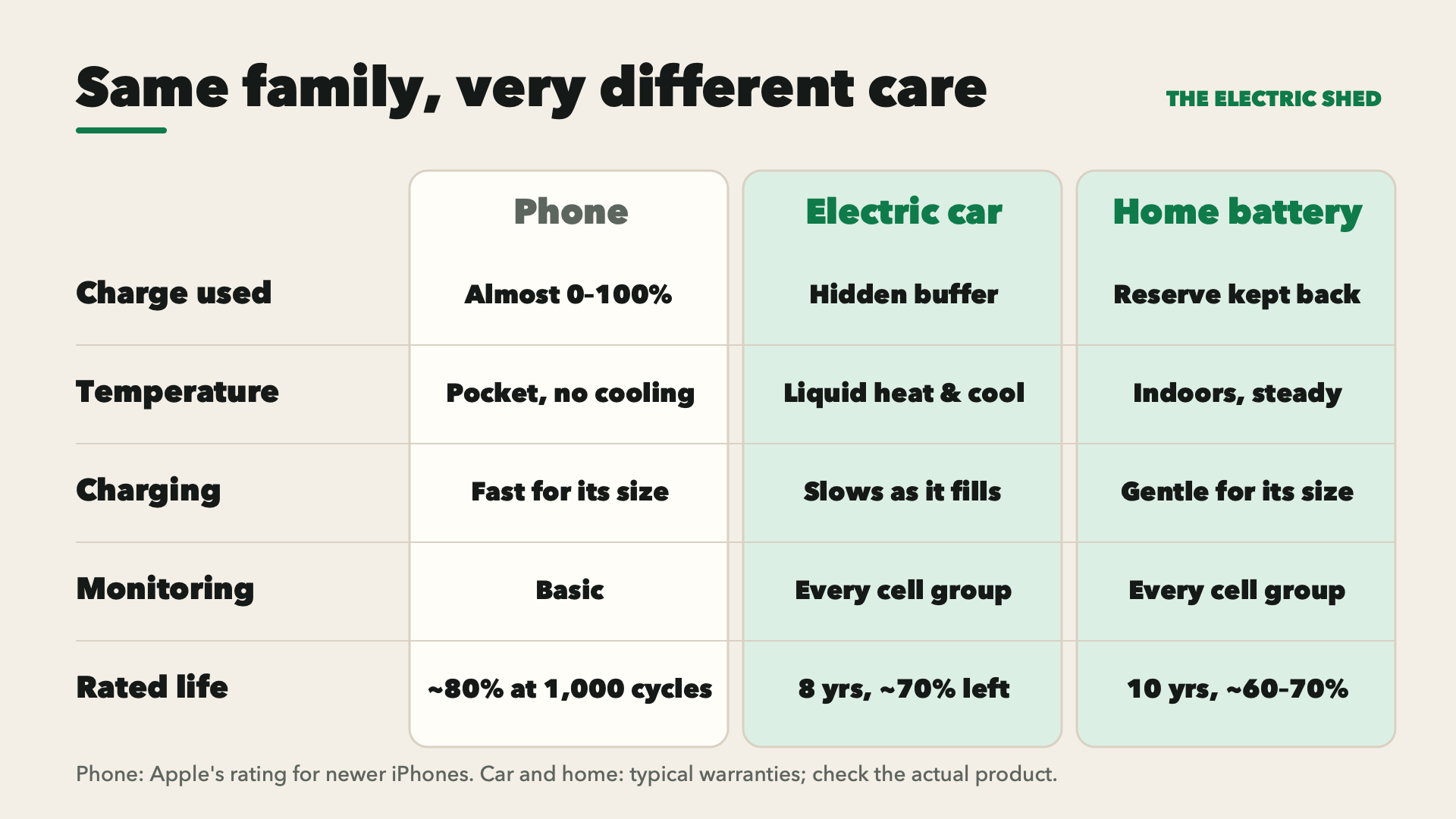
- Phones let you use almost the whole battery, often sit at 100% overnight, get hot in pockets and on wireless chargers, and have no cooling. Even so, Apple rates the iPhone 15 and later at about 80% capacity after 1,000 full cycles. Many phones now offer an option to stop charging at 80%, a trick borrowed from EVs.
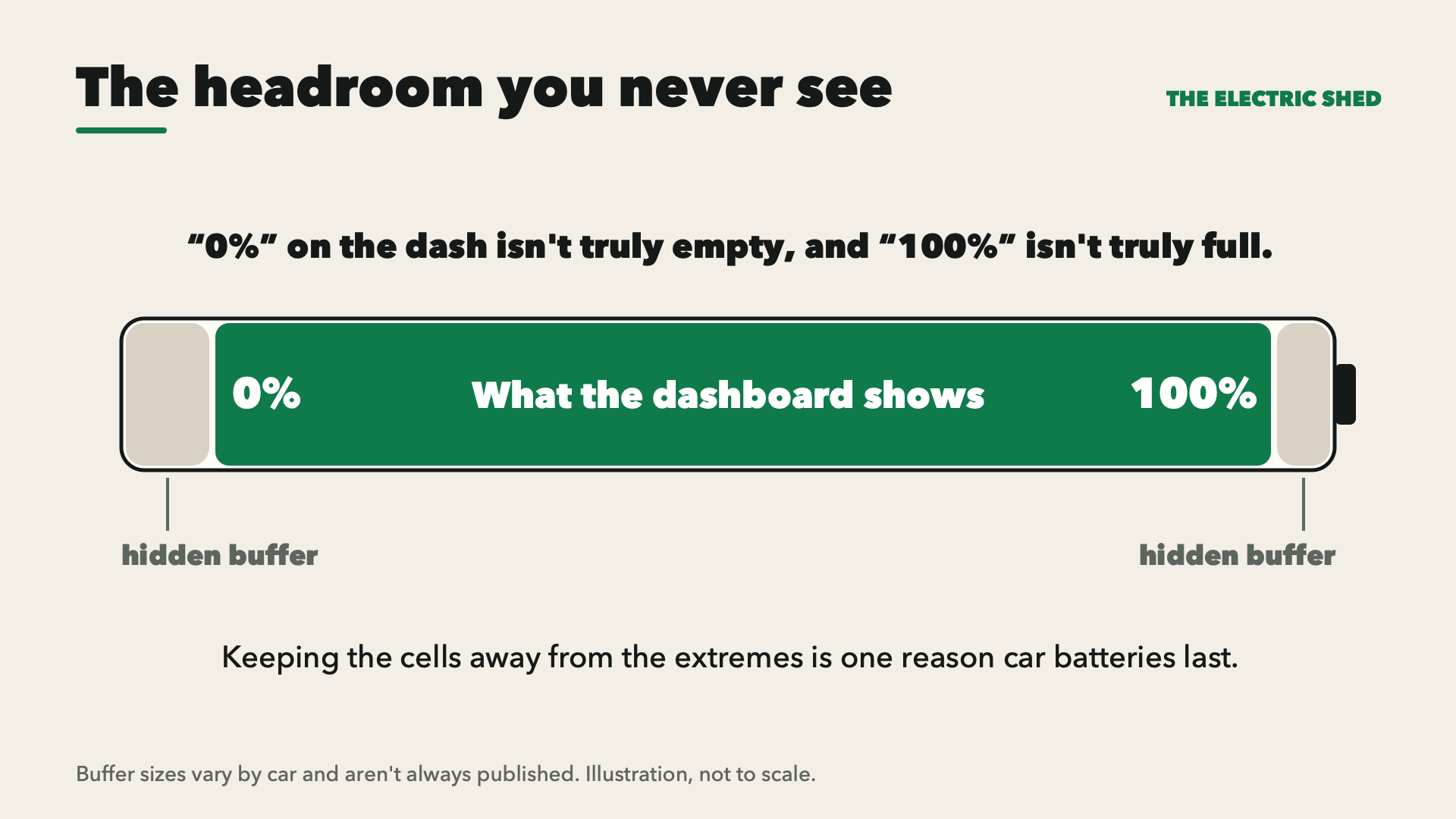
- Electric cars have a battery management system watching the temperature and voltage of every group of cells and keeping them balanced. Most have liquid heating and cooling that works even when parked. They keep hidden headroom at the top and bottom, so "0%" on the dash isn't truly empty. And fast charging deliberately slows as the battery fills. That's why carmakers offer battery warranties of around eight years, often 160,000 km, usually to 70%.
- Home batteries have it easiest. They charge and discharge gently for their size, live in one place out of the weather, and keep a reserve.
Looking after it
- Follow the manual's charging advice. LFP cars often suggest charging to 100% regularly, so the car can keep its range estimate accurate. Nickel-based cars often suggest around 80–90% for daily driving.
- Avoid leaving any battery full and hot for long stretches, such as fully charged in a hot car park for a week.
- Use fast chargers when you need them. Regular heavy use adds wear, but Geotab's data shows the difference is about one percentage point a year, not a cliff.
Should you wait for the next big thing?
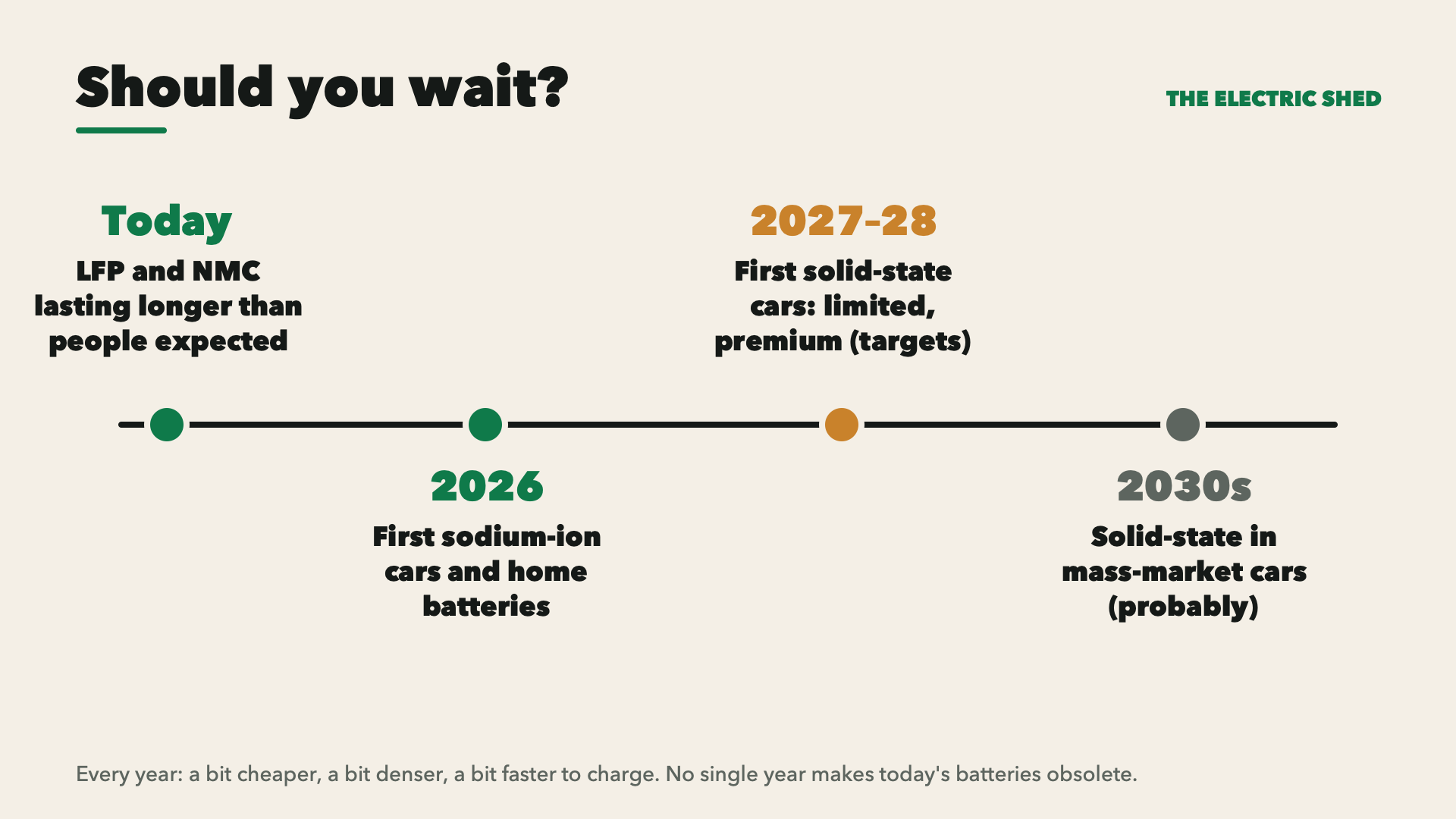
Solid-state batteries have been "a few years away" for about fifteen years. As of late 2026, Toyota and Samsung SDI are targeting 2027–28 for the first cars, starting with limited, premium models, and both have slipped before. Mass-market cars are more likely to get them in the 2030s.
Meanwhile, the improvements that actually reach buyers are steady: batteries get a bit cheaper, a bit denser and a bit faster to charge every year. No single year makes today's batteries obsolete, and today's batteries are lasting longer than early estimates suggested. Every year spent waiting is a year without the savings.
What to check instead
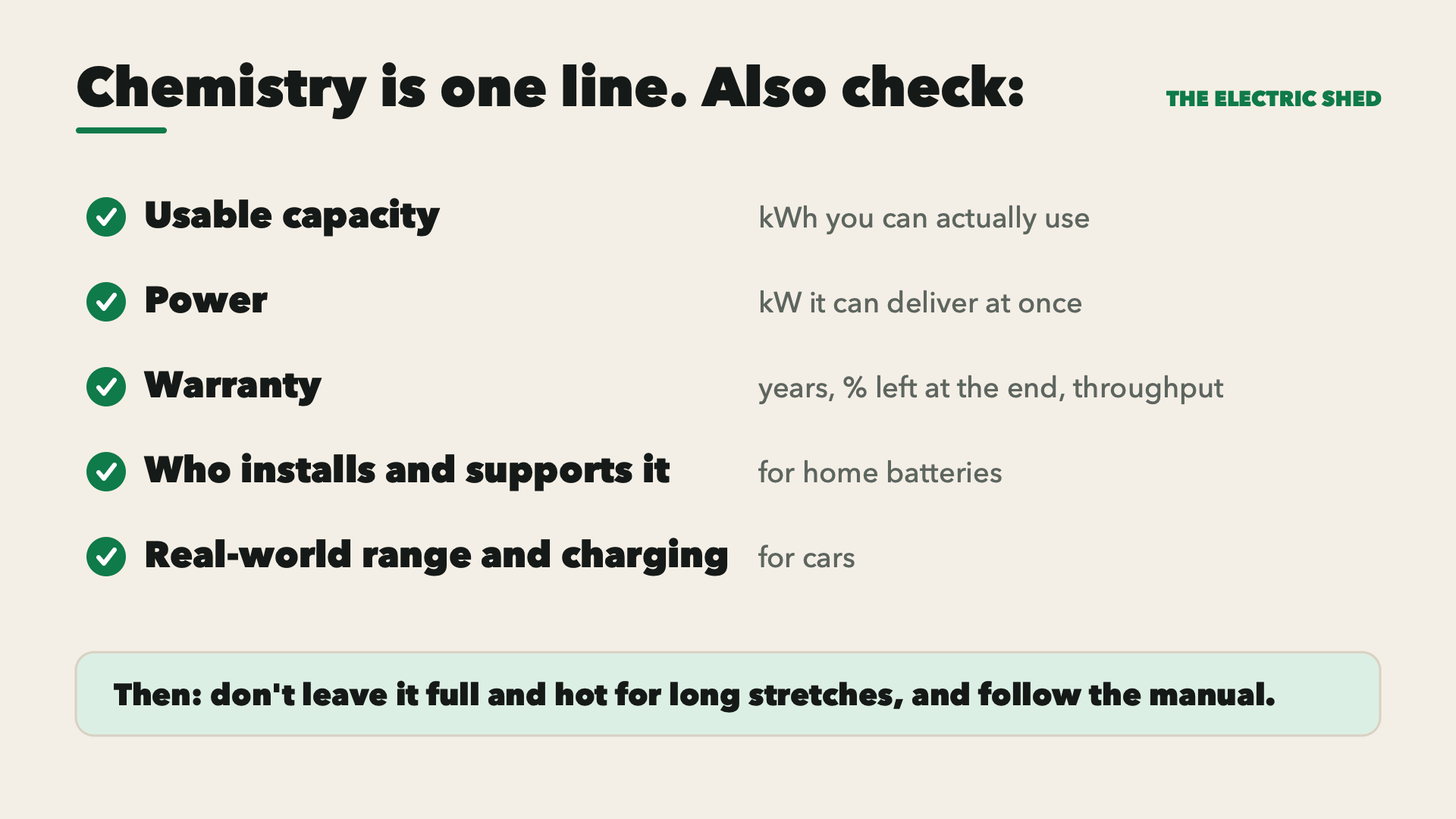
Chemistry is one line on the spec sheet. When you're comparing:
- Usable capacity (kWh): what you can actually use, not the total. If kW vs kWh is still blurry, start there.
- Power (kW): how much it can deliver at once.
- Warranty: years, the percentage of capacity guaranteed at the end, and any throughput limit.
- Who installs and supports it, for home batteries.
- Real-world range and charging speed, for cars. Our sister site, Sweet Commute, has more on how long EV batteries last on the road. And if you charge at home, see how long it takes.
Sources
- Geotab, EV battery health study, 2025 data, published January 2026 (via Electric Autonomy).
- Geslin et al., Stanford University and SLAC, Nature Energy, December 2024 (via IEEE Spectrum).
- Figgemeier et al., "Multi-year field measurements of home storage systems and their use in capacity estimation", Nature Energy, 2024.
- Recurrent, EV battery replacement rates (via InsideEVs).
- IEA, Global EV Outlook 2026: battery chemistry shares.
- Tesla, Impact Report 2022 (battery capacity retention).
- Apple: iPhone 15 battery rating (1,000 cycles to 80%).
Photos: Wikimedia Commons, credited under each image. Diagrams: The Electric Shed.