What does a solar house with a home battery and an electric car actually do all day? We replayed two sunny October days from our own system's data: a Saturday with the car plugged in, and the Monday after, with no car at all. Both had about 38–39 kWh of sunshine; where it went was very different.
The short version
- Same sun, two destinations. After the house and the battery had their share, about 22 kWh a day was spare. On the Saturday it went into the car (about 140 km of driving); on the Monday it went to the grid, for NZ$3.64.
- A sunny charge saved about NZ$2 against charging the same car overnight from the grid (22.4 kWh × 22c = NZ$4.92, against 21.2 kWh × 14c = NZ$2.96 for exporting that sun). Against petrol, the same 140 km would cost about NZ$35.
- The catch: on the car day, the home battery only reached 76%, not 100%. It still ran the house all night and finished at 50%. It would matter after a dull next day.
- The battery's AI mode sold sunshine at breakfast time: 6.2 kWh exported in the weekday morning peak at 19c, then the battery filled from the midday sun. Clever, but worth about 30c.
- Your two numbers: compare what export pays you with the cheapest other way you can charge. In New Zealand and Australia the car usually wins; on some UK tariffs, selling by day and charging at night wins.
Our house
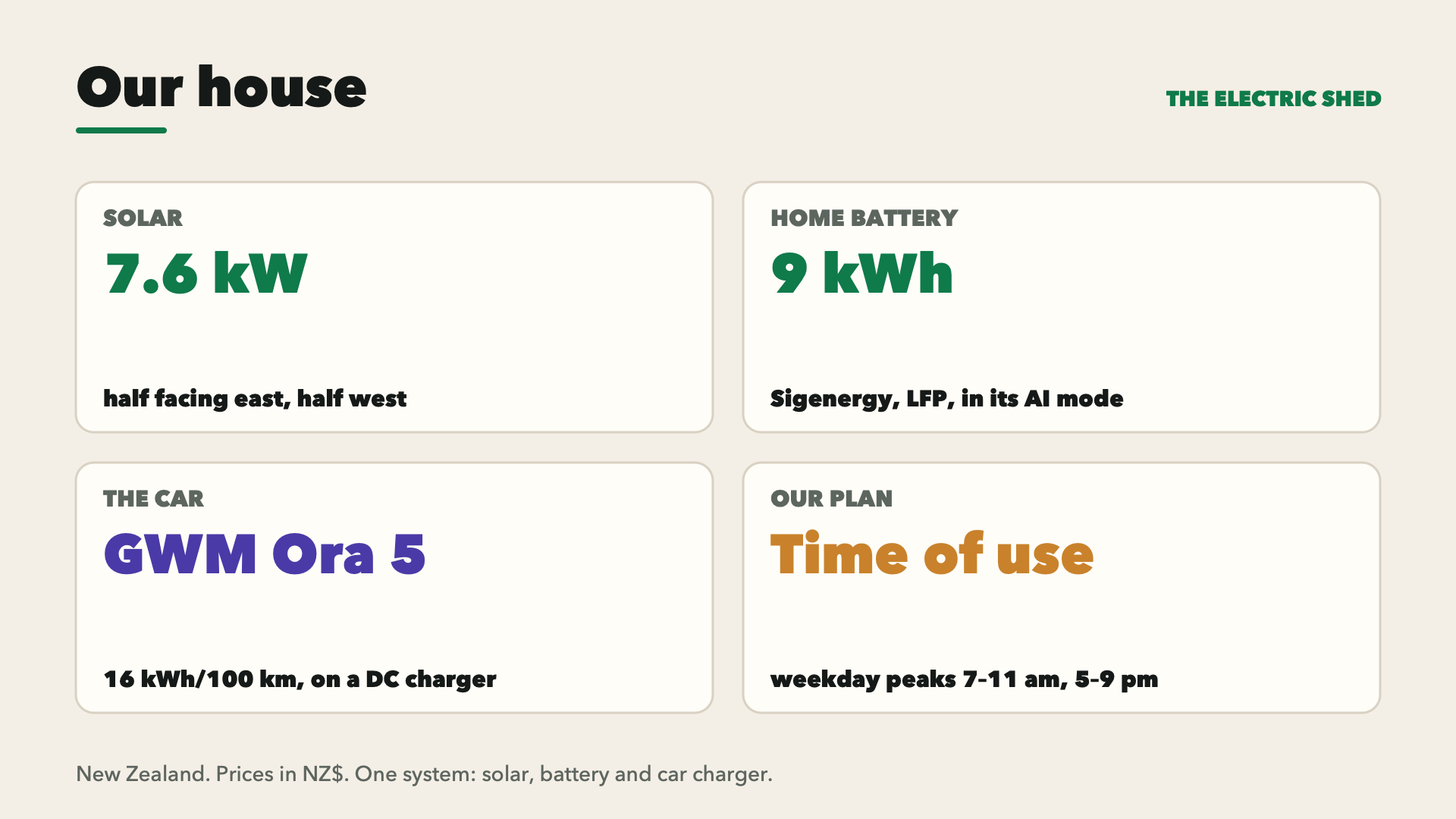
- Solar: 7.6 kW, half facing east and half west, so it makes a long, flat day rather than a midday spike.
- Battery: a 9 kWh Sigenergy LFP battery with whole-house backup, running in Sigenergy's AI mode since it was installed.
- Car: a GWM Ora 5, which averages 16 kWh/100 km for us (our review), charged by a Sigenergy DC charger in the same system (see how long it takes to charge an EV at home).
- Plan (NZ$): weekdays, import 45c and export 19c in the peaks (7–11 am, 5–9 pm), 36c and 14c in the shoulder, 22c overnight (11 pm–7 am). Weekends: 36c by day, 22c overnight, 14c export all day.
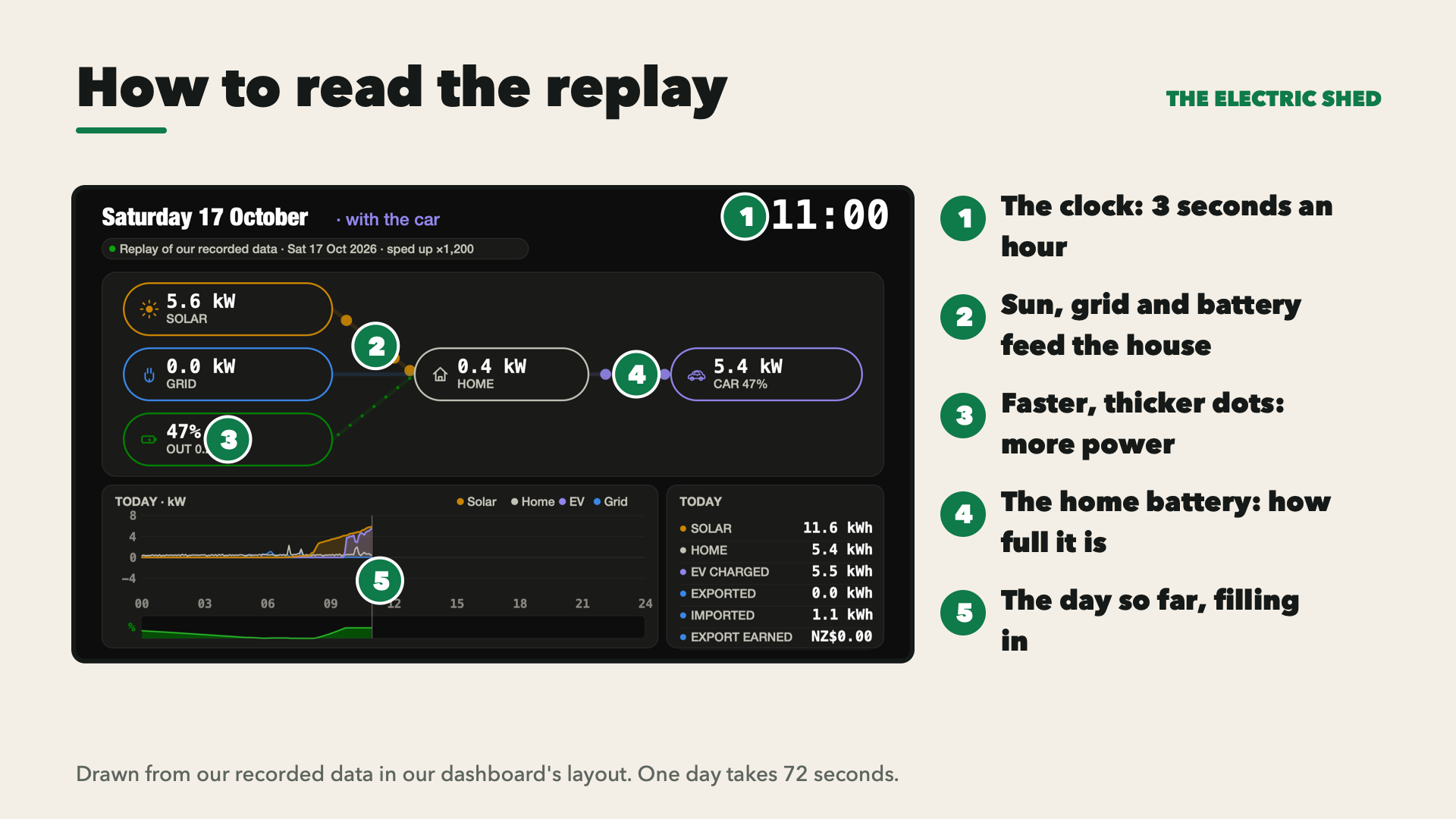
The replays below are drawn from readings our system logged every ~6.5 seconds, in the same layout as the dashboard we use. They aren't screen recordings. In the video, one day takes 72 seconds (sped up ×1,200).
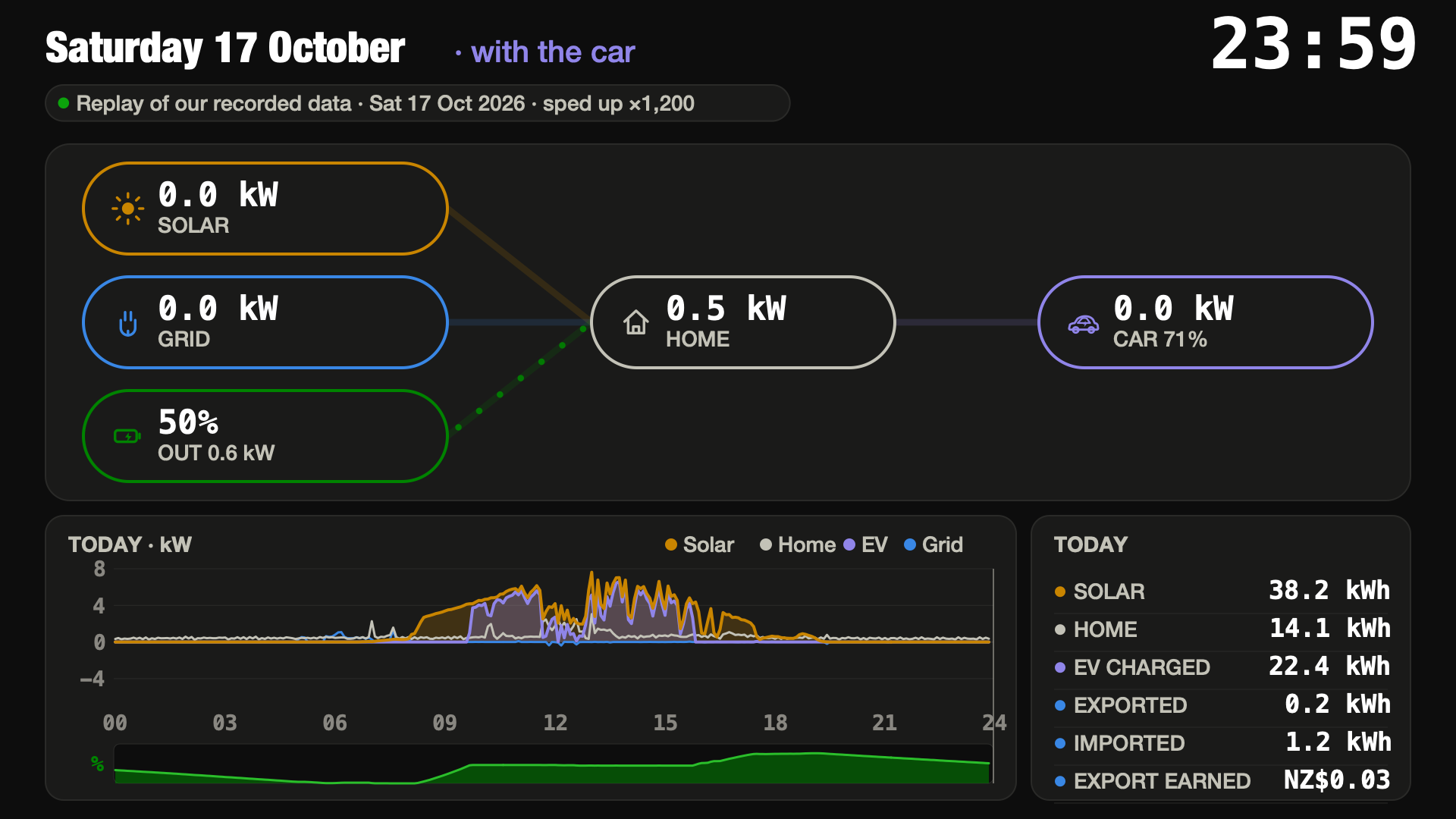
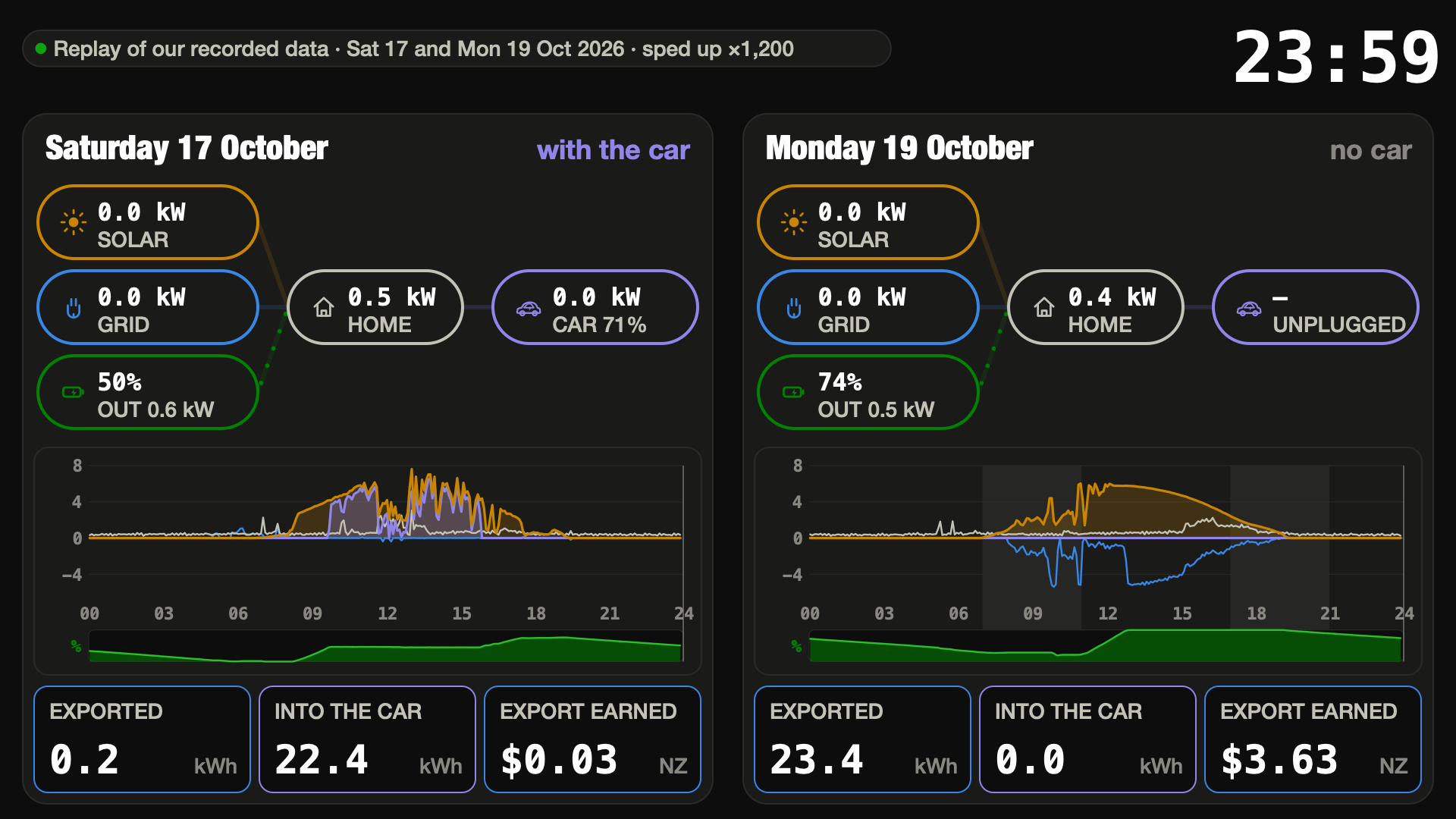
Saturday 17 October: with the car
- Midnight to dawn: the house ticks over on about 0.4 kW from the battery, which starts at 34% and runs out at 5:42 am. We buy a little from the grid until the sun's up (0.9 kWh at 22c).
- 8 am: every spare watt goes into the home battery, which reaches about 40% by 9:40.
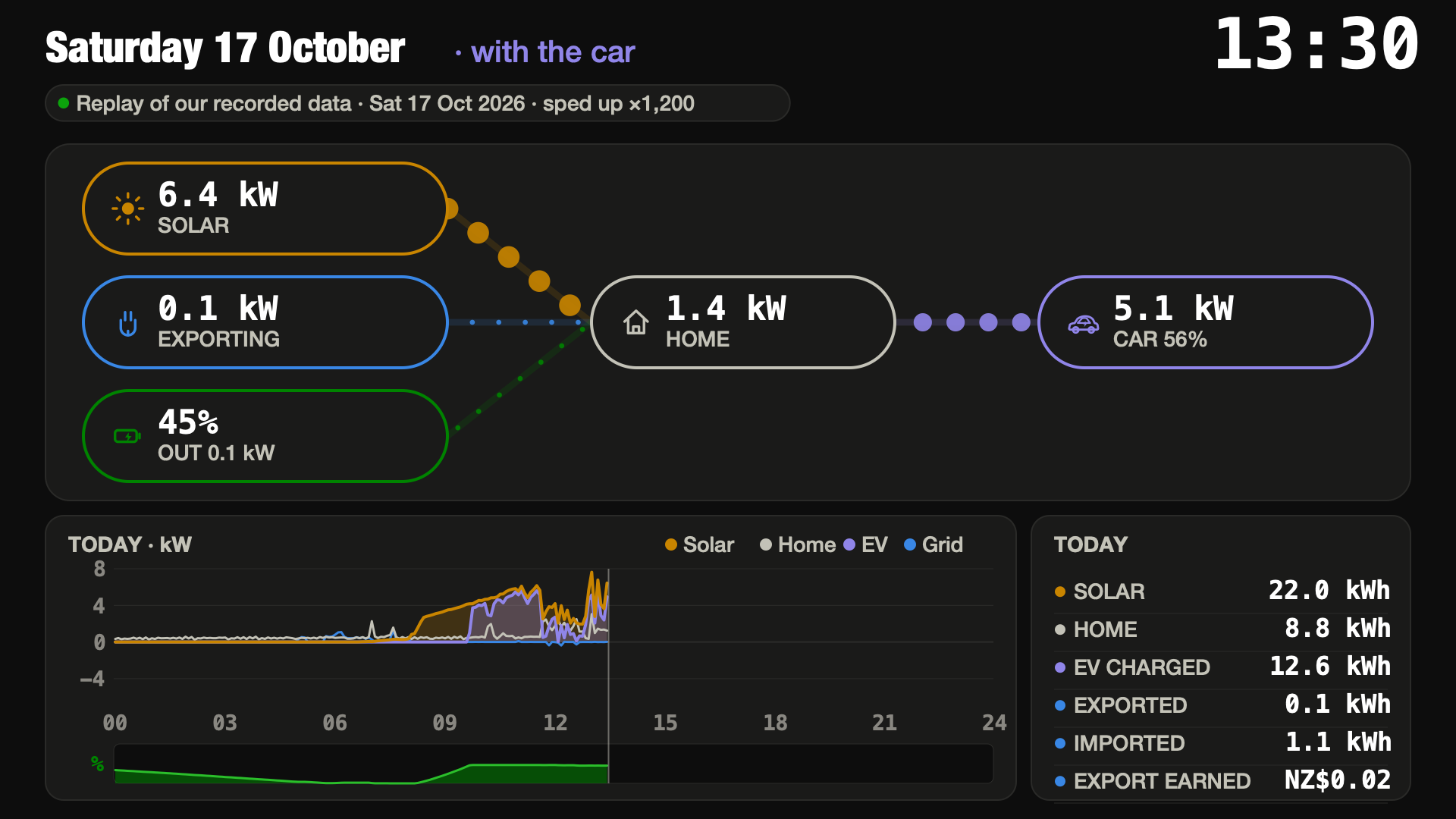
- 9:43 am: the car's plugged in. From here, the sun goes into the car at 3–6 kW. The home battery holds at 45–47%.
- 3:48 pm: the car's done: 22.4 kWh in (by the charger's own log, 22.0 kWh, 21.2 of it from the sun). The battery then fills to 76% by 7 pm.
- Evening: the battery runs the house overnight and ends the day at 50%.
- Day total: bought 1.3 kWh (NZ$0.33), sold 0.3 kWh.
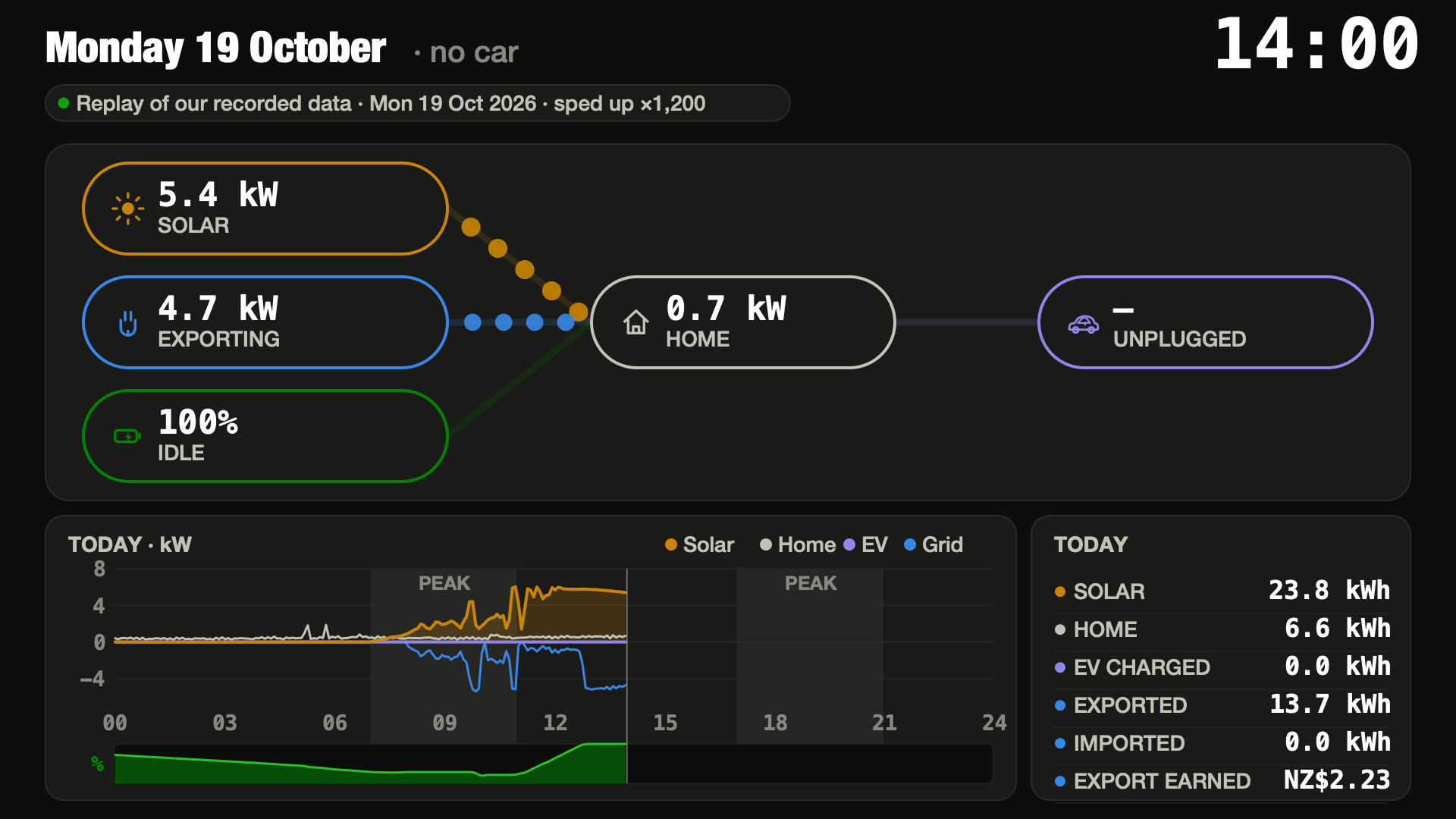
Monday 19 October: no car
- Midnight to 7 am: the battery starts nearly three-quarters full (72%) and runs the house; 29% by 7 am.
- 7–11 am, the morning peak: the sun comes up, but the battery doesn't charge. The system sends the sunshine to the grid at 19c, and even lets the battery down to 19% by 10 am.
- From 11 am: export drops to 14c, and the battery fills: full at 12:53 pm.
- Afternoon: nowhere left for the sun to go. The house needs about 0.5 kW, and about 5 kW goes to the grid for hours.
- 7 pm onwards: the battery runs the house and ends the night at 74%.
- Day total: sold 23.4 kWh for NZ$3.64 (6.2 kWh in the morning peak and 1.0 kWh in the evening peak at 19c, 16.2 kWh at 14c); bought 0.07 kWh.
Side by side
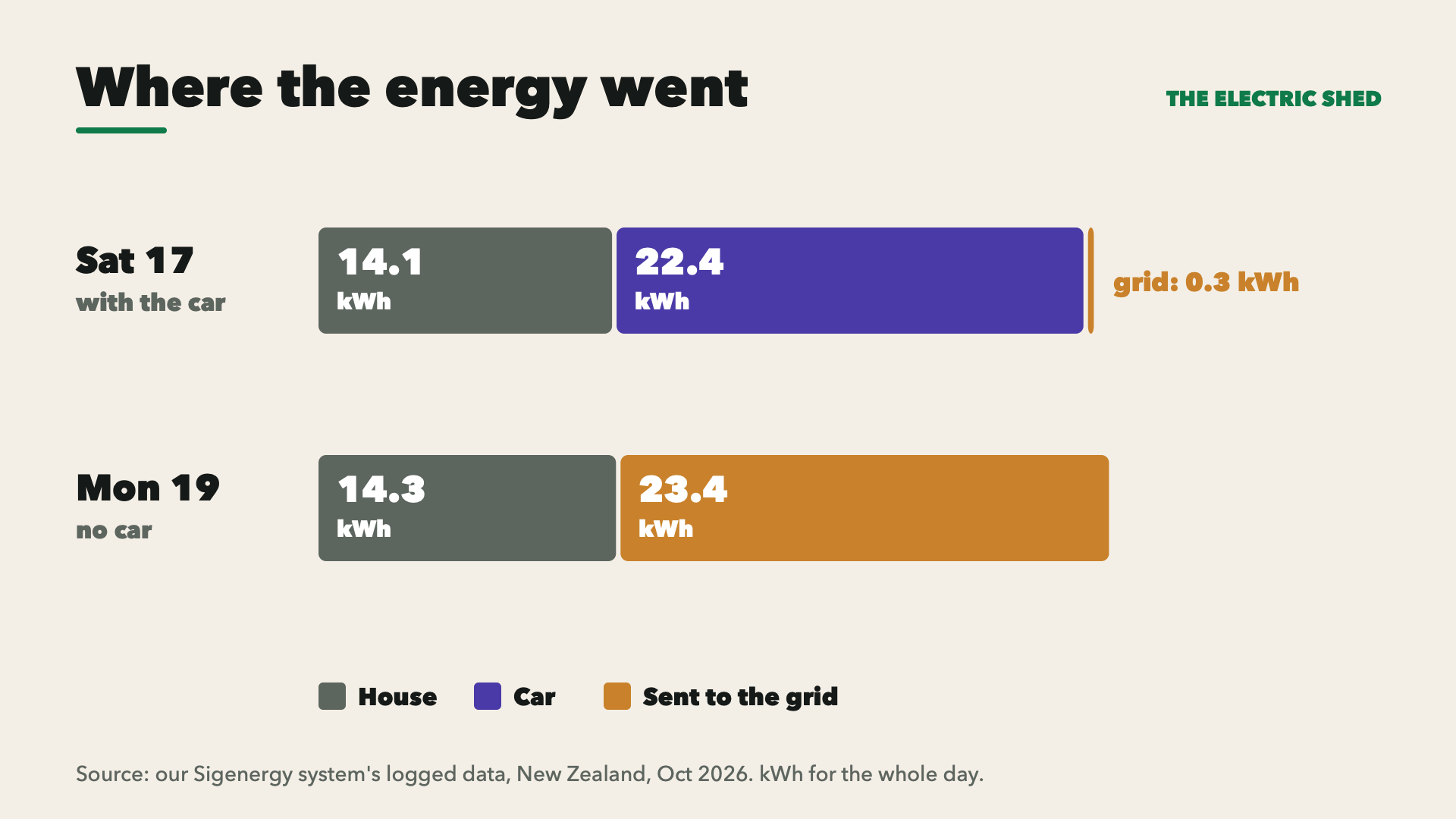
The house used about 14 kWh on both days, and we bought next to nothing from the grid on either. The difference is where the spare ~22 kWh went: into our own car, or out to the neighbours.
Sell it, or drive it?
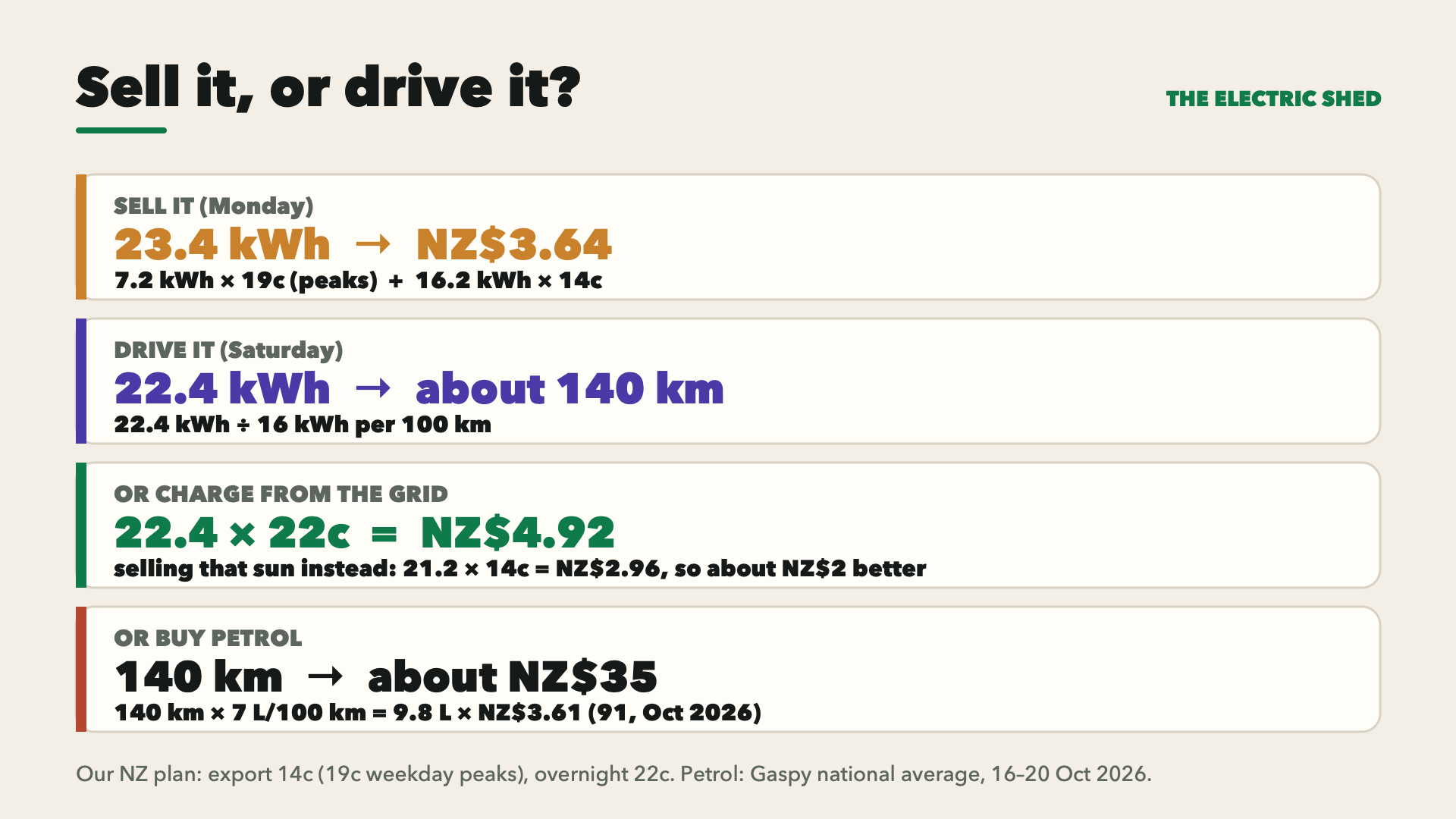
- Sell it: the Monday's 23.4 kWh earned NZ$3.64.
- Drive it: the Saturday's 22.4 kWh is about 140 km (22.4 ÷ 16 kWh/100 km).
- Instead of the grid: without the sun, we'd charge overnight at 22c: 22.4 × 22c = NZ$4.92. Selling the 21.2 kWh of sun that went in would have earned 21.2 × 14c = NZ$2.96. So the sunny charge was worth about NZ$2 that day.
- Instead of petrol: 140 km in a small petrol SUV at 7 L/100 km is 9.8 L; at a record NZ$3.61/L for 91 (October 2026), about NZ$35.
The catch: the home battery doesn't fill
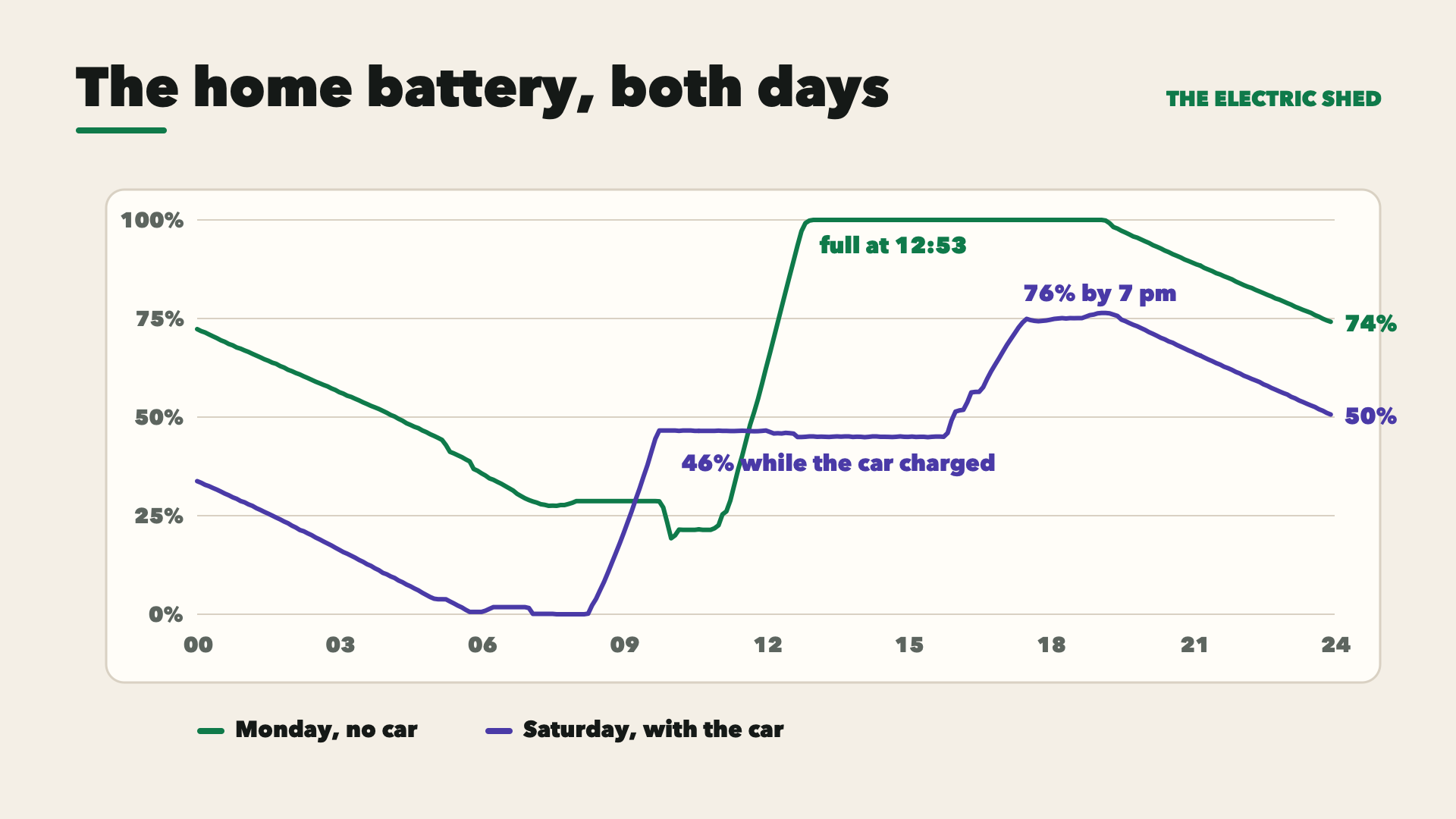
On the car day, the battery sat at 46% until the car was done and only reached 76% by sunset. That night it didn't matter: it ran the house and still had half left. The cost shows up after a dull day, when a half-full battery runs out sooner and you buy from the grid, possibly at the peak rate. On the Saturday itself, all our importing cost NZ$0.33.
Our order of play: the car first, in the middle of the day; then let the battery fill in the afternoon.
The battery's breakfast trick
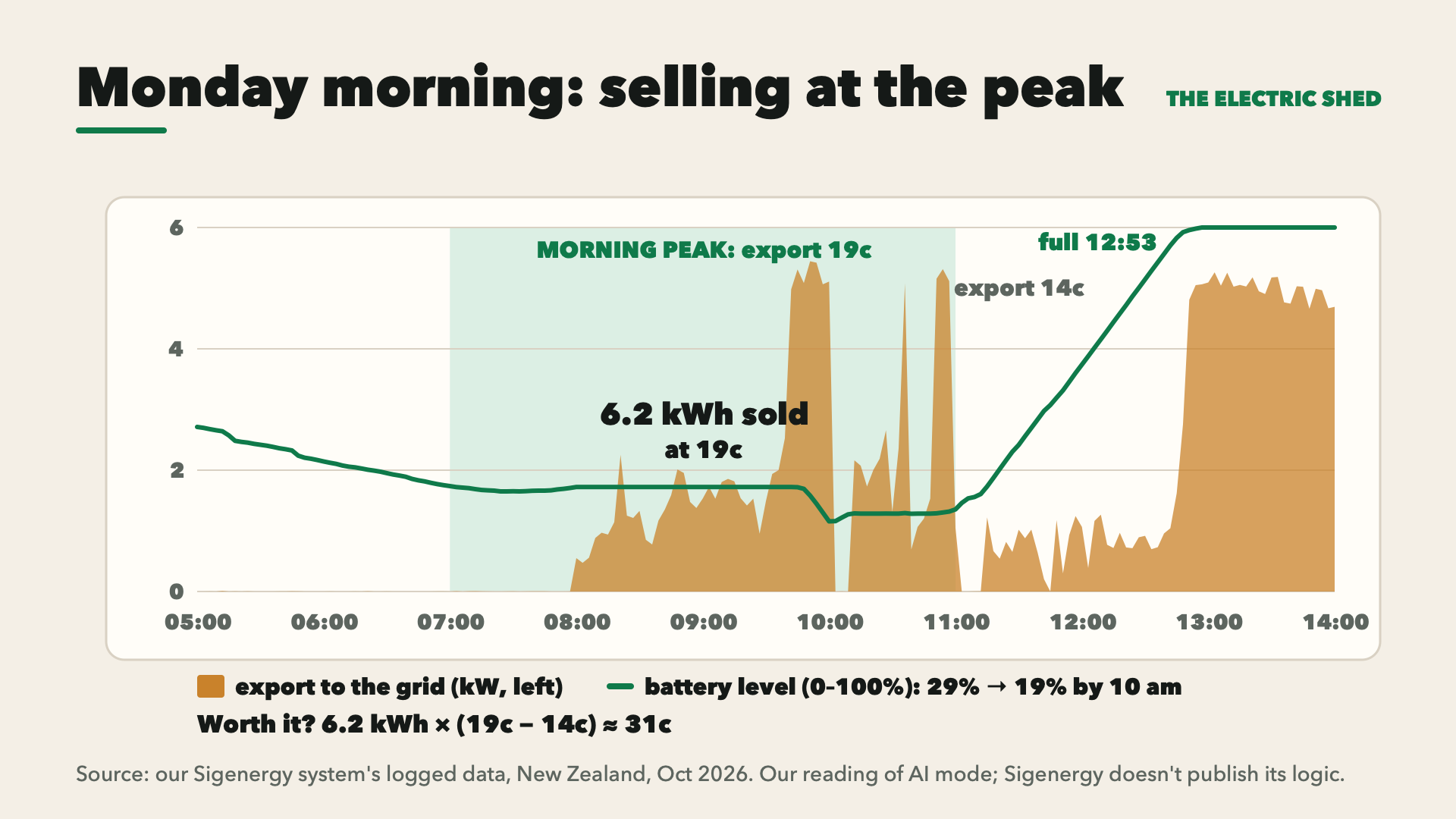
On weekday mornings our plan pays 19c for exports, against 14c later. On the Monday, the AI mode didn't charge the battery from the morning sun: it exported 6.2 kWh at 19c and let the battery fall from 29% to 19% (about 1 kWh out). From 11 am, when export dropped to 14c, it filled the battery from the midday sun. That's our reading of the data; Sigenergy doesn't publish how AI mode decides.
Was it worth it? 6.2 kWh × 5c ≈ 31c. At weekends our export rate is 14c all day, so there's no peak to chase. For more on whether a battery pays its way, see is a home battery worth it?
Your two numbers
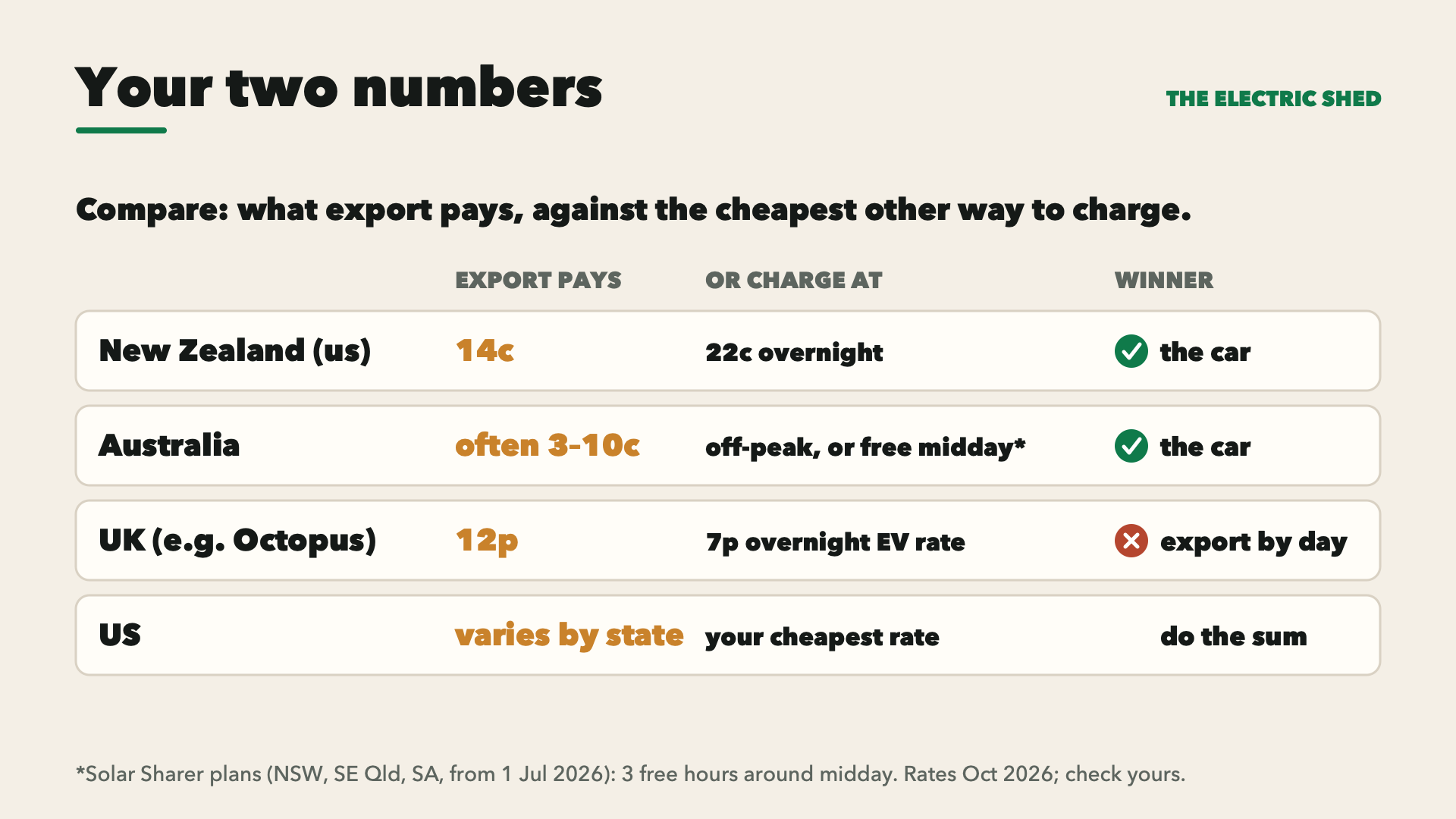
Whether your spare sunshine is worth more in your car or on the grid comes down to two numbers: what export pays, and the cheapest you could charge the car otherwise.
- New Zealand (us): 14c against 22c overnight. The car wins by about 8c/kWh.
- Australia: feed-in tariffs are often 3–10c/kWh (October 2026), so the car wins by more. On a Solar Sharer plan (NSW, south-east Queensland and South Australia, since 1 July 2026), three hours around midday are free from the grid anyway, so a midday charge costs nothing either way.
- UK: some tariffs flip it. With Outgoing Octopus at 12p and Intelligent Octopus Go at about 7p overnight, selling by day and charging at night comes out ahead.
- US: it depends on your state's net-metering or export rules. Do the same sum.
Driving an EV? Our sister site, Sweet Commute, has the EV driver's version of this story.
Sources
- Our own data (New Zealand): our Sigenergy system's dashboard archive, readings every ~6.5 seconds, Saturday 17 and Monday 19 October 2026; the car's charging-session log. Our NZ time-of-use plan (weekend rates checked against the dashboard's daily totals).
- Petrol: Gaspy national average for 91, NZ$3.61/L, 16–20 October 2026, via RNZ and NZ Fuel Watch.
- Australian feed-in tariffs: AER plan data, via Solar Power Savings, October 2026.
- energy.gov.au and CHOICE: the Solar Sharer Offer.
- Octopus Energy: Outgoing Octopus 12p/kWh from 1 March 2026; Octopus, Intelligent Go rates: 7p/kWh off-peak.
- The GWM Ora 5's 16 kWh/100 km: our own average, from our Ora 5 review.
Diagrams and replays: The Electric Shed, drawn from our recorded data.