A home battery can add a lot to the cost of going solar. In New Zealand this year, a typical solar-only install came in at around NZ$17,000; add a battery of about 9 kWh and the typical total was closer to NZ$31,000. So is it worth it?
The house behind this channel has had solar and a battery for nearly nine months, through a whole winter. This is the first instalment of a series: the real numbers now, worked through, and the same sums for Australia and the UK. We'll check again at one year.
The short version
- The solar has been a good investment. It does most of the saving, and pays for itself in roughly 8–10 years.
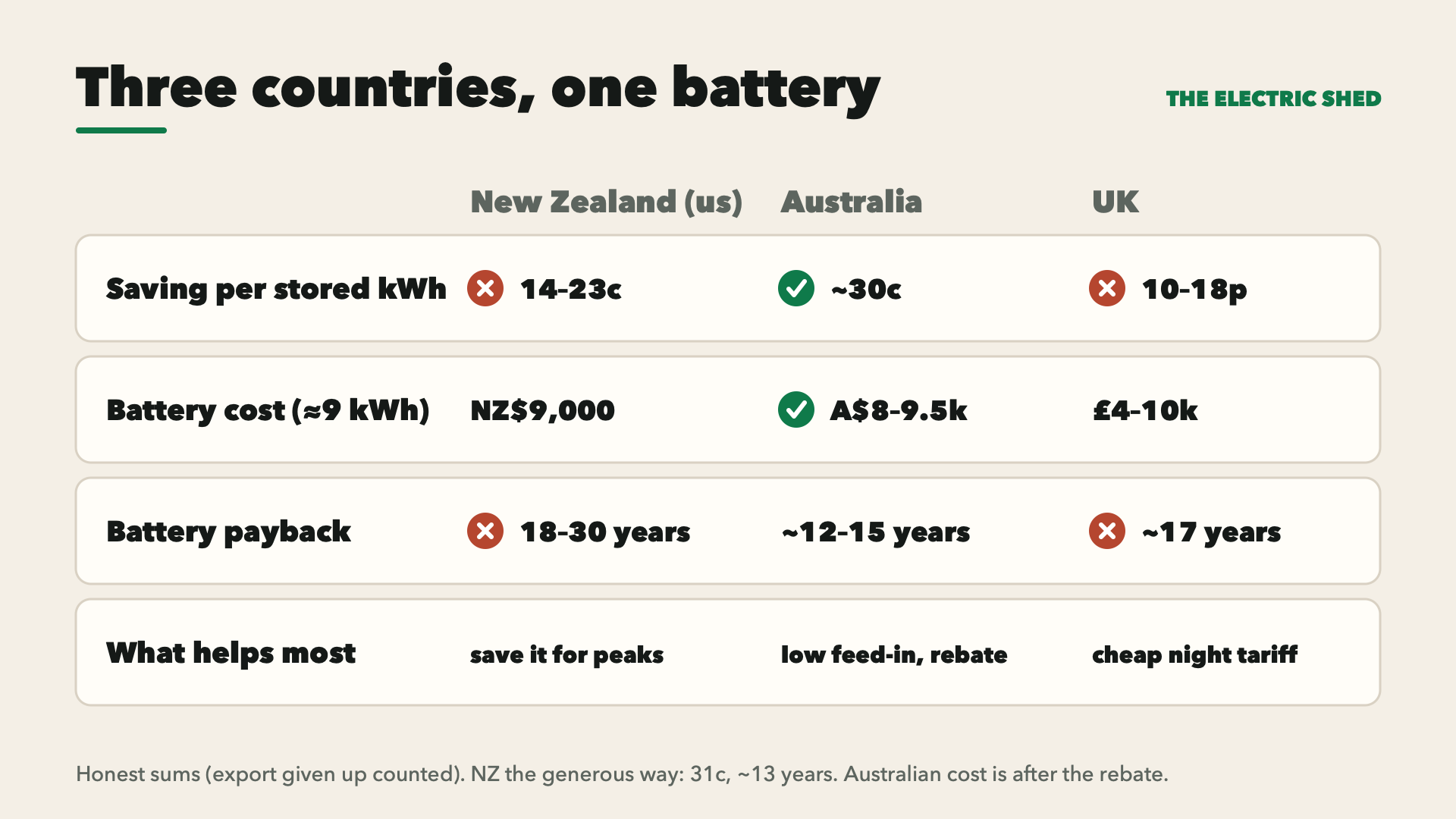
- The battery, on bill savings alone, doesn't pay back yet. On the strictest sum it saves us about NZ$300–500 a year. On a NZ$9,000 battery, that's 18–30 years, against a 10-year warranty.
- The reason: in spring, our east-facing panels already cover the morning peak and the battery covers the evening. It ran out of expensive hours, so its spare energy went into the cheapest ones.
- In much of Australia the sum is closer: low feed-in tariffs and the federal rebate make a stored kWh worth about twice as much.
- We'd still buy it again. Whole-house backup, 79% of our power from our own roof, and the satisfaction of running on sunshine day and night are worth it to us. They won't be to everyone.
What a battery adds to the cost
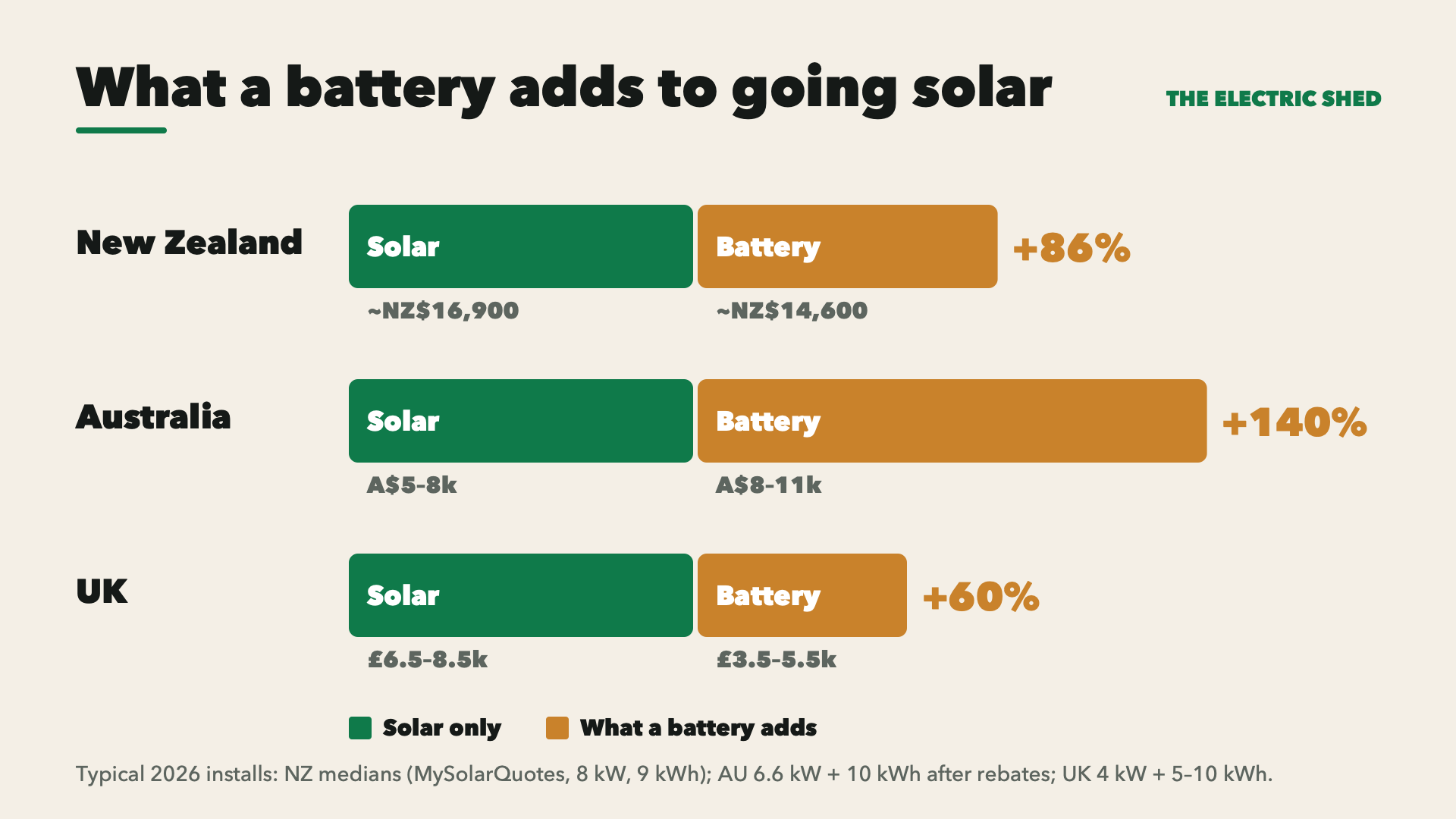
- New Zealand: the median solar-only system (8 kW) cost about NZ$16,900; solar with a 9 kWh battery about NZ$31,500 (MySolarQuotes 2026 data). The battery nearly doubles it.
- Australia: a 6.6 kW system is typically A$5,000–8,000 after the STC discount (SolarQuotes), and a 10 kWh battery A$8,000–11,000 after the federal rebate. The battery can cost more than the panels.
- UK: a 4 kW system is typically £6,500–8,500, and £10,000–14,000 with a battery (Heatable): roughly half again.
Our system
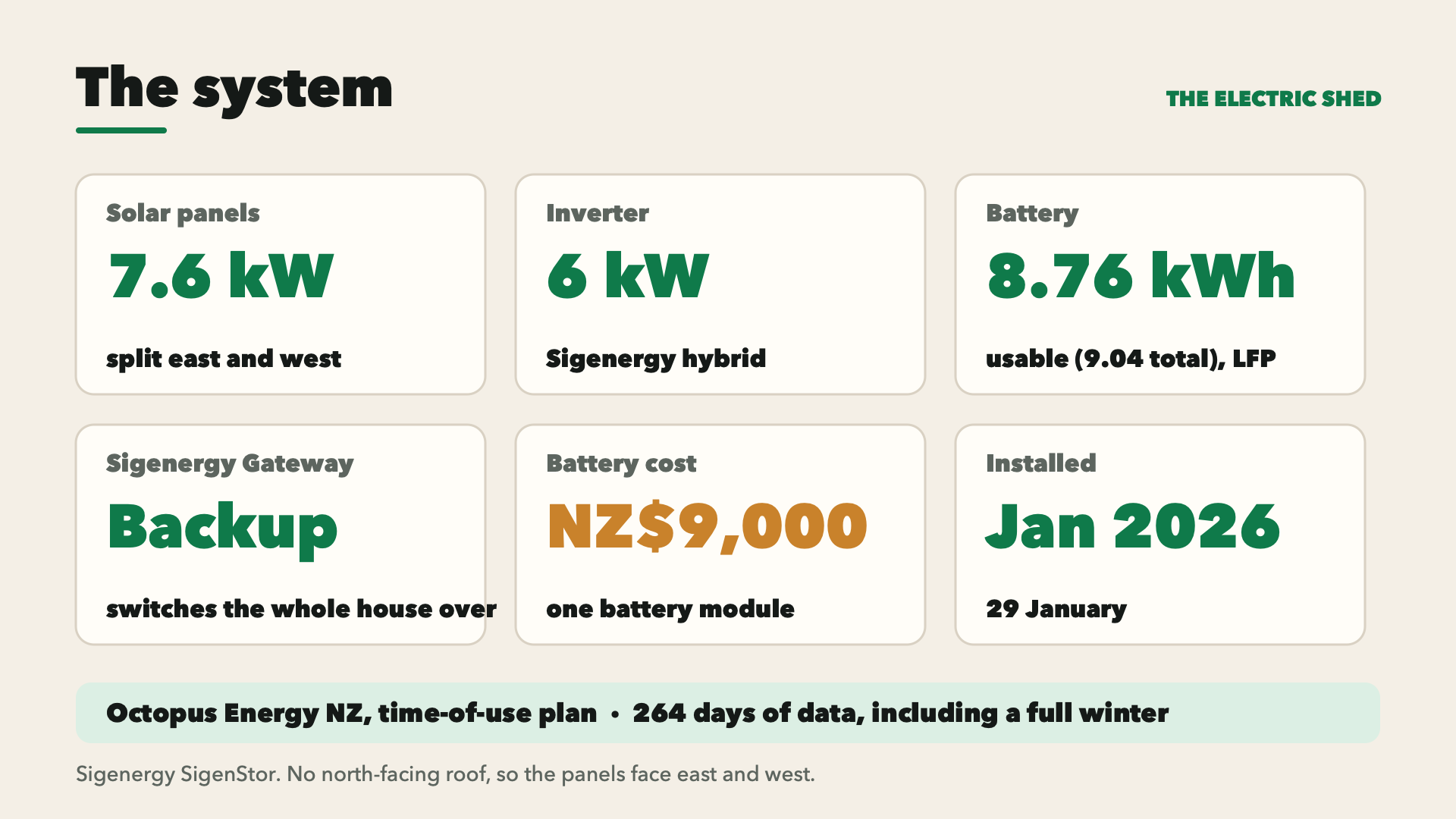
- 7.6 kW of solar panels, split east and west. There was no good north-facing roof (south, in the northern hemisphere), but we'd have chosen east–west anyway: the panels start earlier and finish later, with a flatter curve, so there are more hours of useful power, including the morning peak.
- A 6 kW Sigenergy hybrid inverter.
- One Sigenergy battery module: 9.04 kWh in total, 8.76 kWh usable, LFP (the long-life chemistry; see battery types explained).
- A Sigenergy Gateway: it sits between the house and the grid, and if the grid goes down, it switches the whole house to the solar and battery.
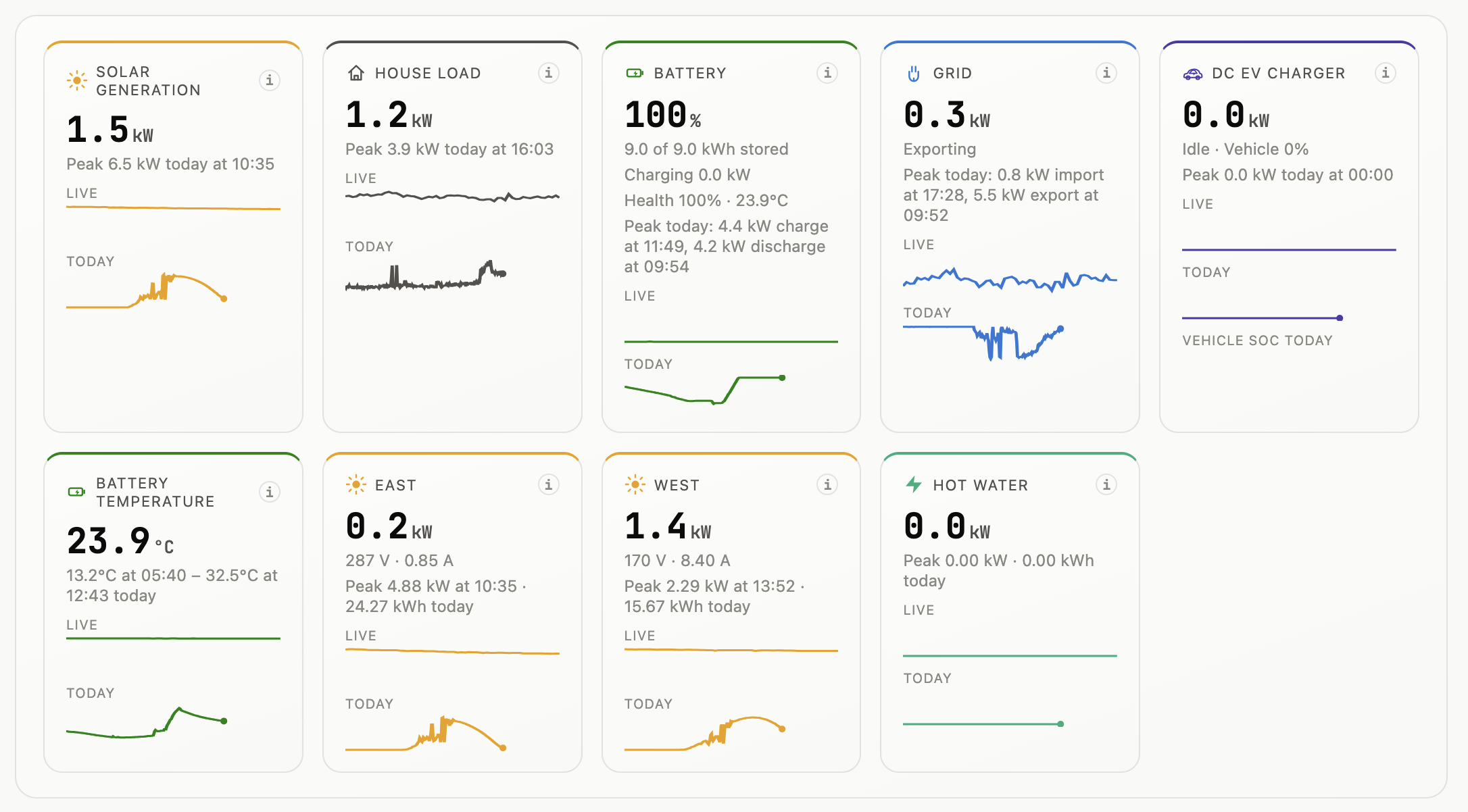
Our tariff
We're with Octopus Energy NZ on a time-of-use plan:
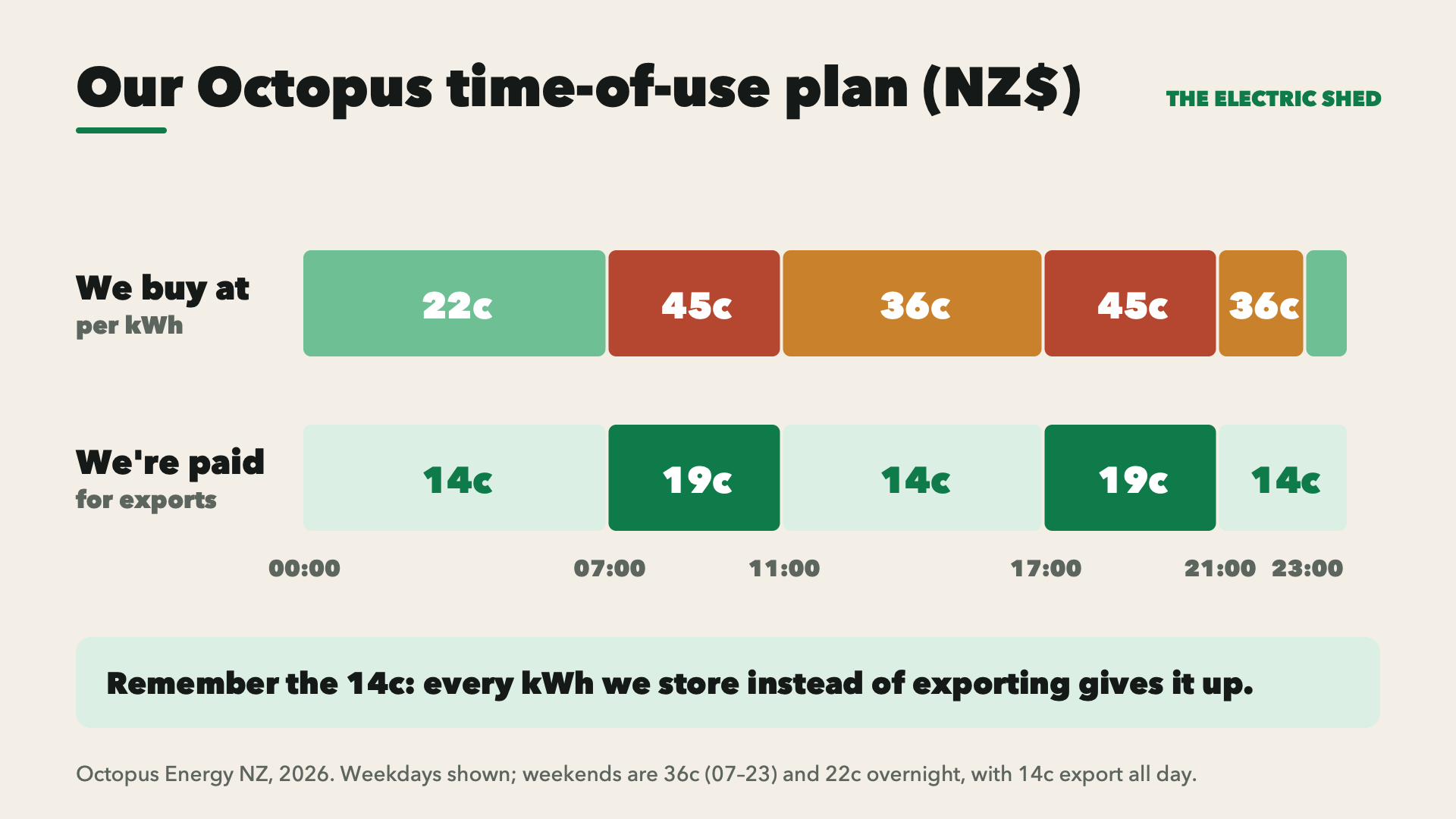
That 14c export rate turns out to matter a lot. (If you're in New Zealand and thinking of switching, our Octopus referral link gives you and us NZ$50 credit each.)
Nine months in numbers
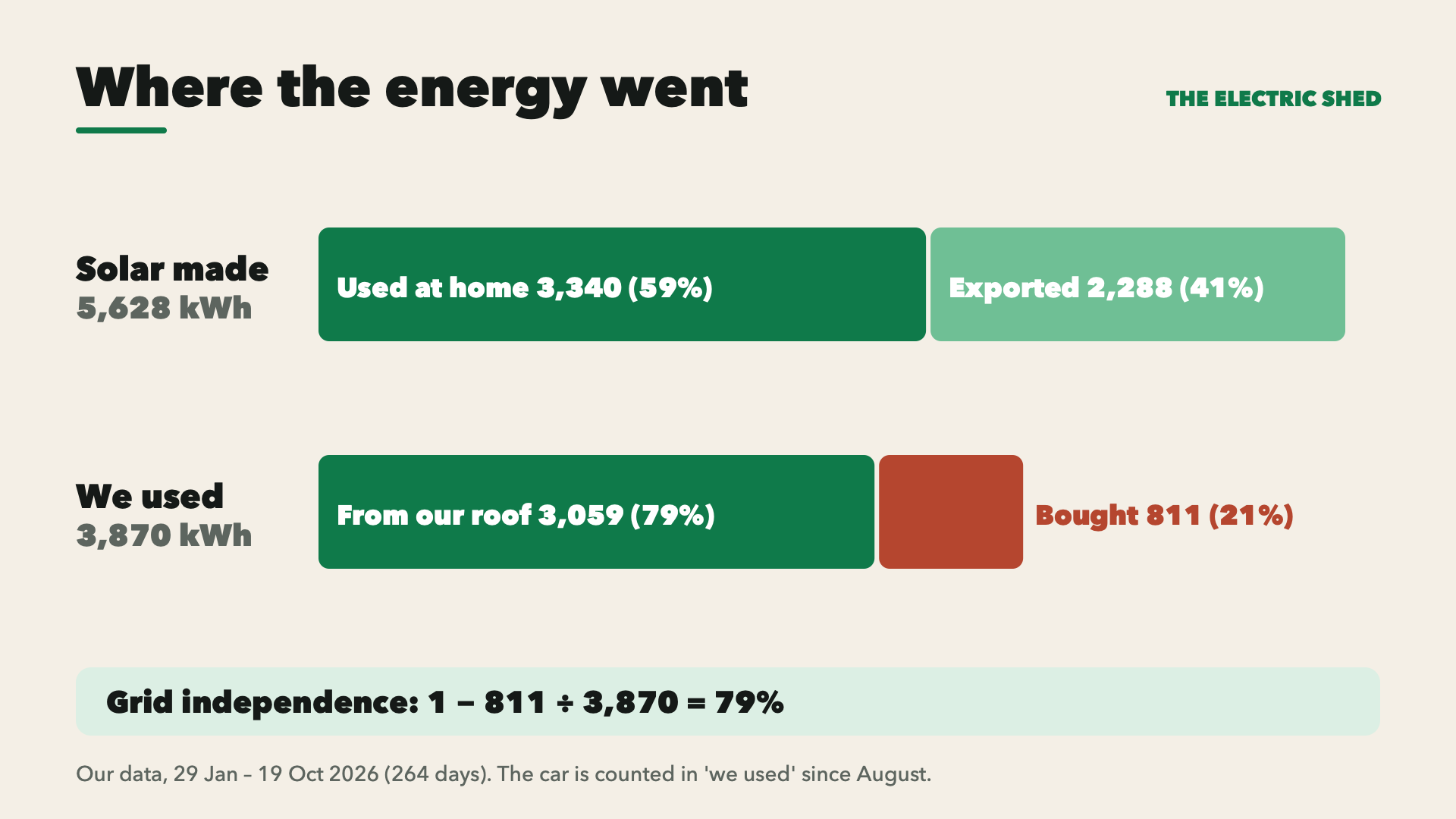
From 29 January to 19 October 2026, 264 days:
kWh | |
|---|---|
Solar made | 5,628 |
House and EV used | 3,870 |
Bought from the grid | 811 |
Exported | 2,288 |
Battery gave back | 1,565 |
- 2.8 kWh a day per kW of panels (5,628 ÷ 7.6 ÷ 264), with a winter in it. A handy number if you're comparing systems; see how much power a 6.6 kW system produces.
- 79% of everything we used came from our own roof (1 − 811 ÷ 3,870), directly or through the battery.
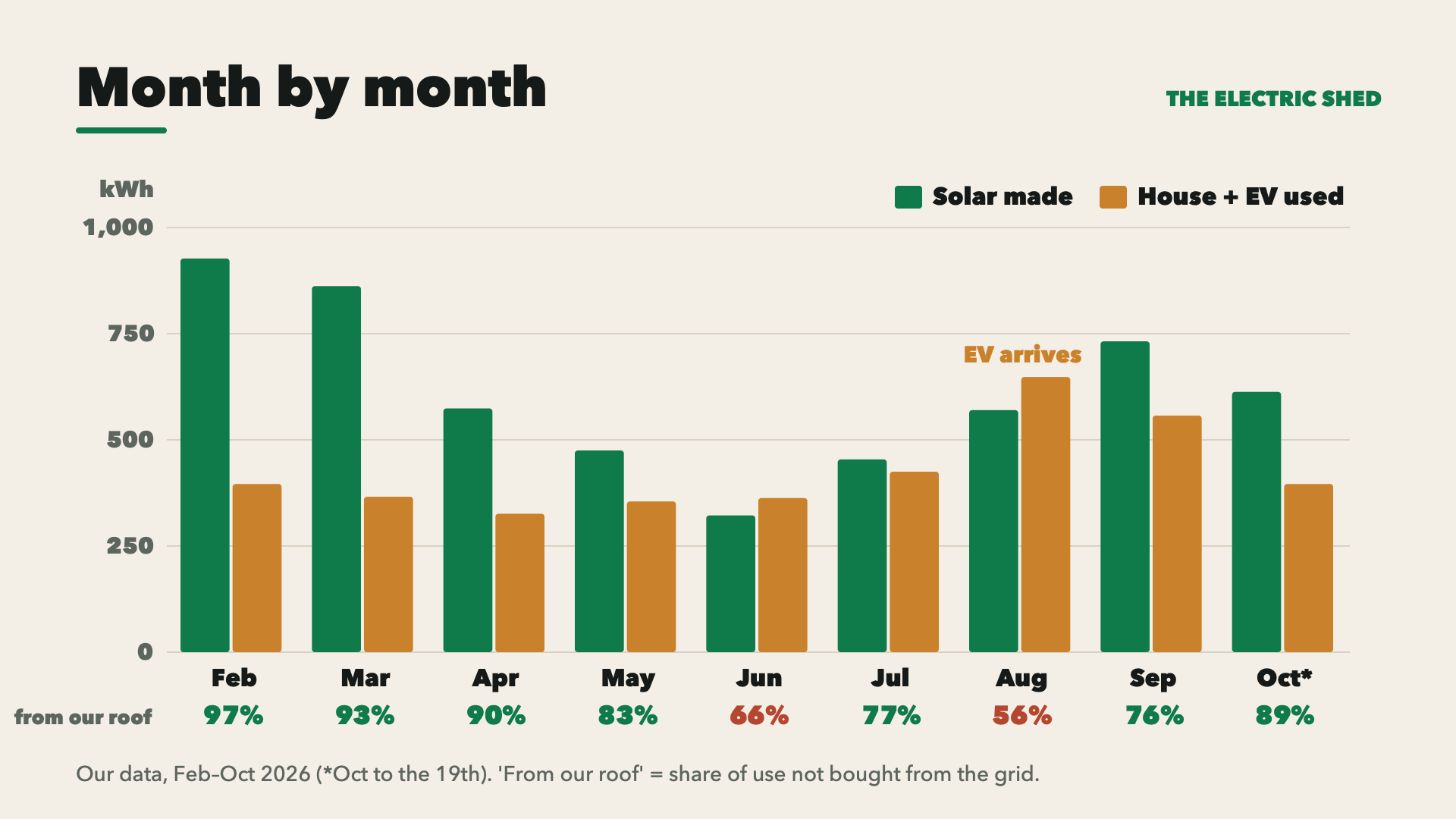
- Summer was almost free: we bought 11 kWh in all of February. June was the low point, with a third from the grid. In August the car arrived, use jumped by half, and the share from our roof fell to 56%.
- We still exported 2,288 kWh, about 40% of what the panels made.
What it saved
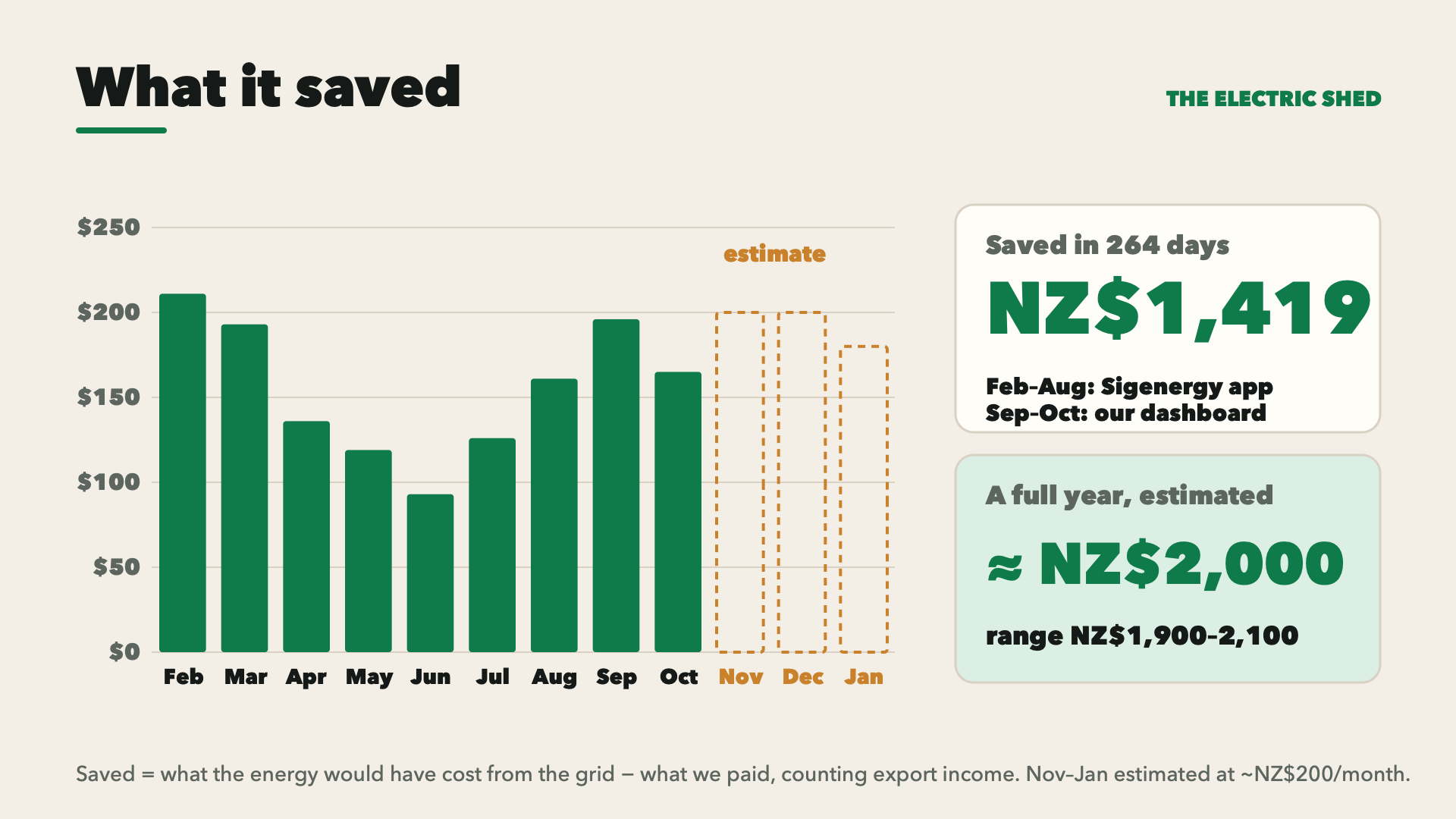
Solar and battery together saved NZ$1,419 in 264 days: what the power would have cost from the grid, minus what we actually paid, counting export income.
Two honest notes:
- Two methods. February to August is Sigenergy's own figure, from its app; September onwards is our own time-of-use calculation. Same idea, slightly different method.
- The sunniest months are missing. If November to January look like February and March, about NZ$200 a month, a full year comes to roughly NZ$2,000 (NZ$1,900–2,100). We'll know at the one-year mark.
How much of that is the battery?
This is the question if you already have solar. Our battery gave back 1,565 kWh in 264 days, about 2,160 kWh a year.
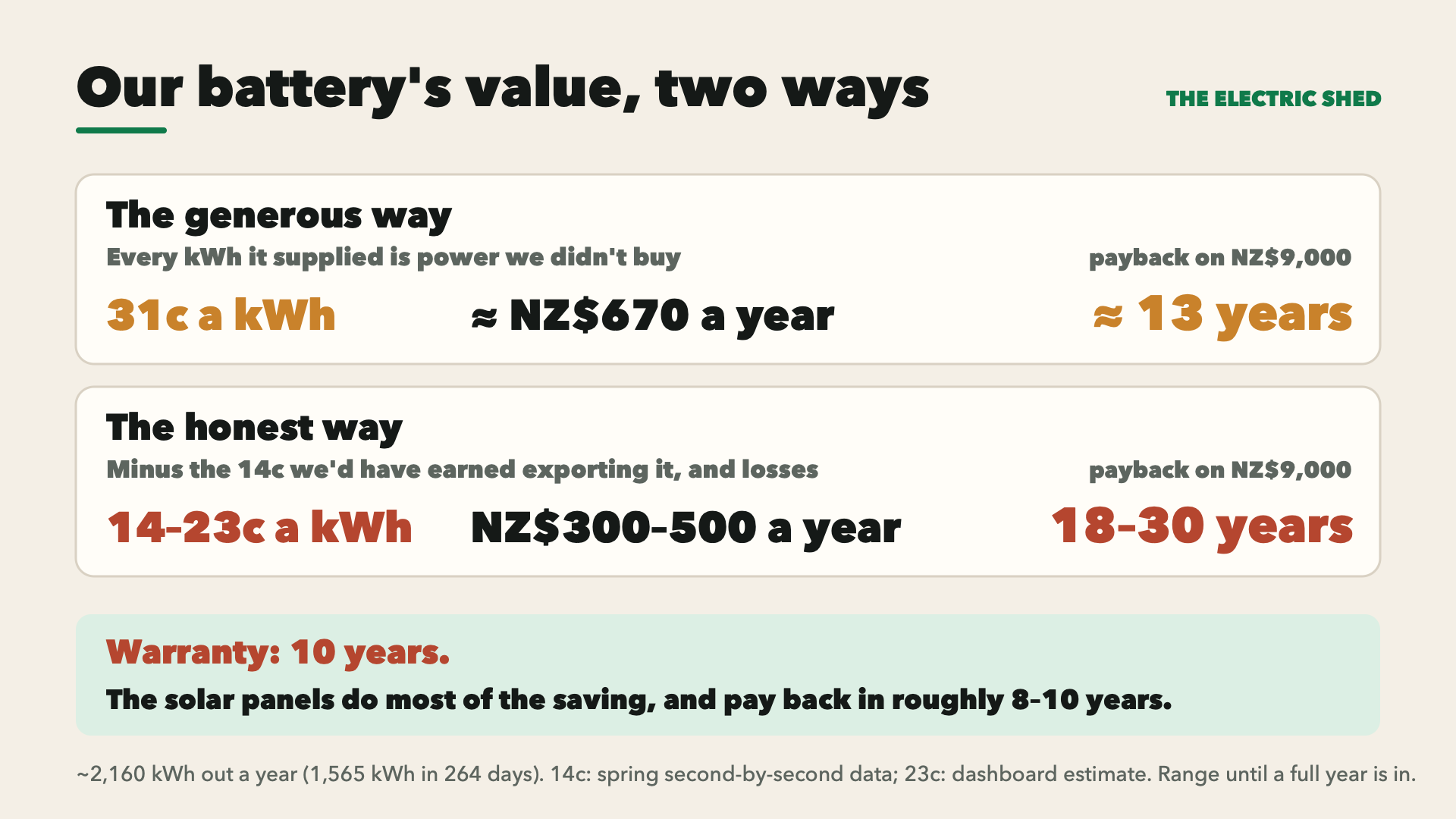
- The generous way: every kWh the battery supplied is power we didn't buy. At the price for each time of day, that averages 31c: about NZ$670 a year, or about 13 years on NZ$9,000.
- The honest way: stored solar isn't free. Without the battery we'd have sold it for 14c, and about a tenth is lost going in and out. Take those off and each kWh saved 14–23c, depending on the month: NZ$300–500 a year, or 18–30 years.
We worked it out three ways and they agree: second-by-second data for one spring month (14c, about NZ$305 a year); a whole-period check of what solar alone would have saved (about NZ$335 a year); and the dashboard's earlier estimate, which allows for better value in winter (23c, about NZ$500).
What one stored kWh is really worth
The sum that decides whether a battery pays:
Saving per stored kWh = the price you'd otherwise pay − (the export money you gave up + about a tenth for losses)
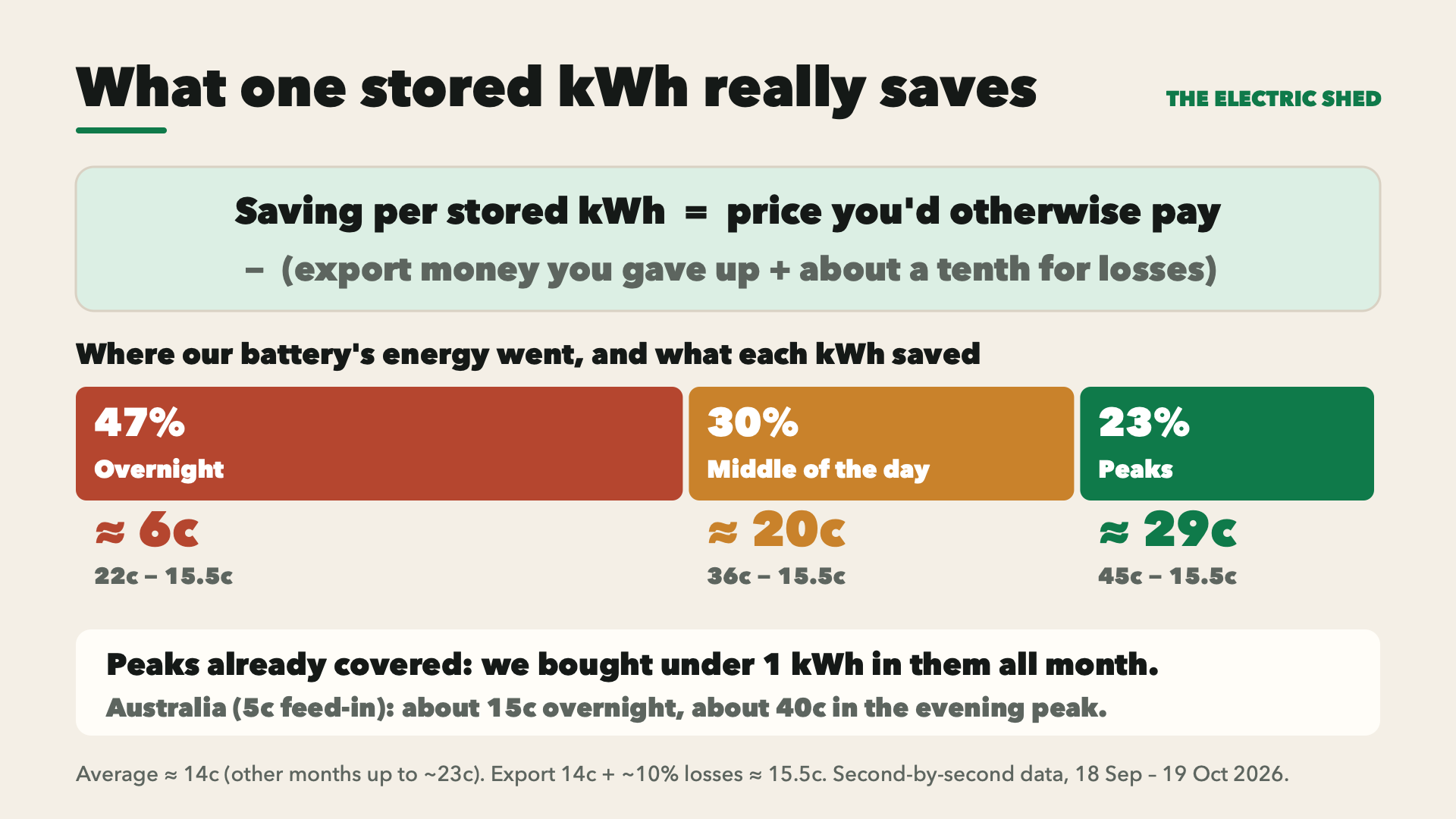
With our 14c export rate (15.5c with losses), a stored kWh saves about 29c in the 45c peak, about 20c at 36c, but only about 6c overnight at 22c.
And that's the catch. In a month of second-by-second data, we bought less than 1 kWh from the grid in the morning and evening peaks, all month. The east-facing panels cover the mornings, and the battery covers the evenings. So the battery ran out of expensive hours, and nearly half of what it gave out went into the overnight hours, when grid power is cheapest. In spring at least, our battery is bigger than our peaks.
Period | Bought from grid | Battery supplied |
|---|---|---|
Weekday morning peak (45c) | 0.2 kWh | 19 kWh |
Weekday evening peak (45c) | 0.7 kWh | 38 kWh |
Shoulder and weekends (36c) | 3.4 kWh | 73 kWh |
Overnight (22c) | 81 kWh | 117 kWh |
18 September to 19 October 2026.
What would change our battery's sum
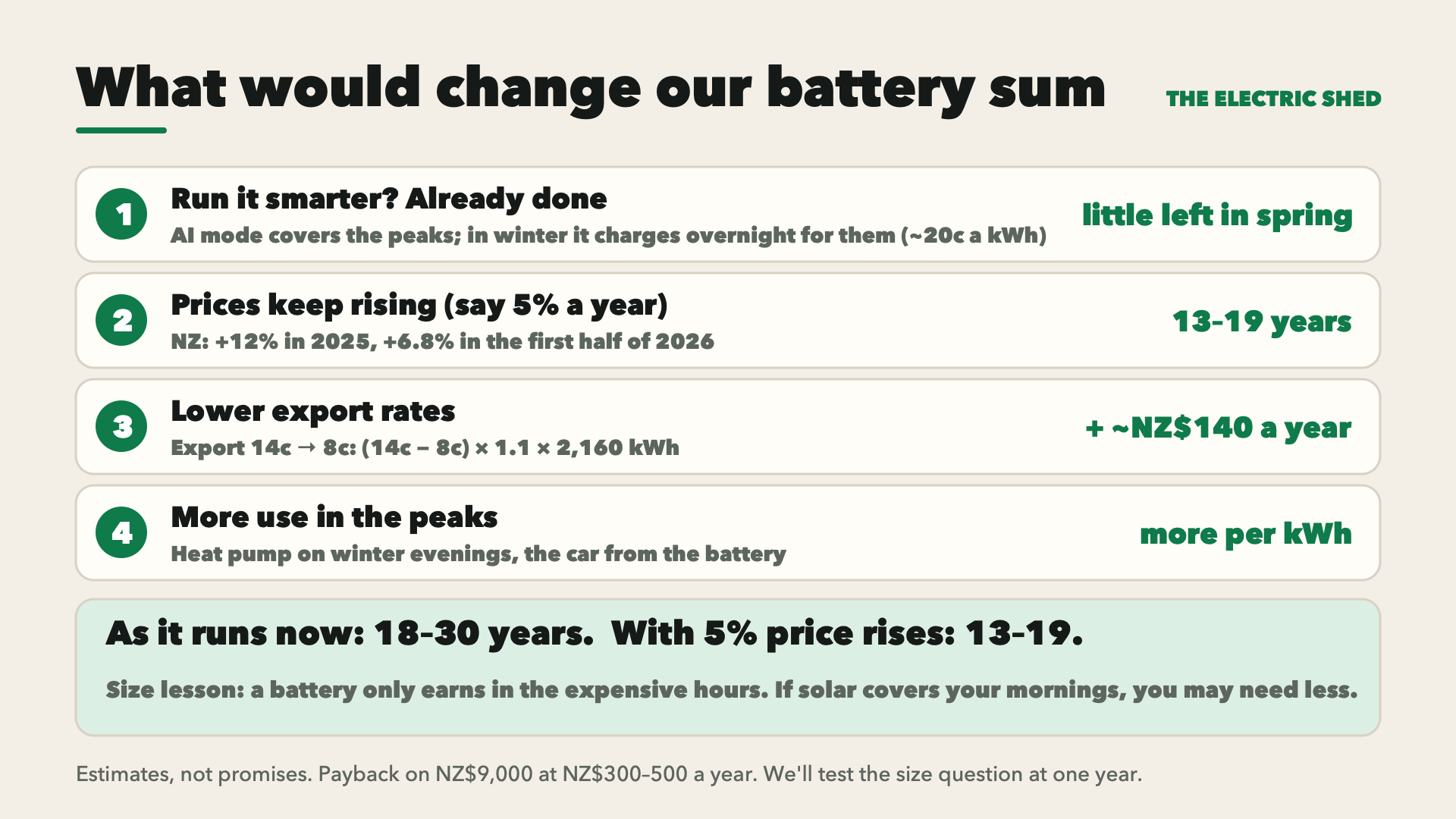
- Run it smarter? Already done. The battery has been on Sigenergy's AI mode since day one. It uses the solar forecast and our tariff, and will charge from the grid overnight, or hold its charge, if that avoids buying at higher rates the next day. In winter, when the panels can't cover the peaks, that's what it does, and those kWh are worth about 20c each (45c − 22c with losses). In spring there's almost nothing left to improve.
- Prices keep rising. NZ power prices rose about 12% in 2025 (Consumer NZ) and 6.8% in the first half of 2026 (Electricity Authority). At 5% a year from here, the battery pays back in about 13–19 years.
- Lower export rates. Every cent off the export rate is worth more than a cent per stored kWh. From 14c to 8c: (14c − 8c) × 1.1 × 2,160 kWh ≈ NZ$140 a year more.
- More use in the peaks: a heat pump on winter evenings, or charging the car from the battery.
The size lesson. A battery only earns its keep in the expensive hours. If your solar already covers the mornings, as east-facing panels do, you may need less battery than you think. A smaller one might have paid back faster for us, at least outside winter. We'll test that at one year.
Is a home battery worth it in Australia?
The same battery, Australian sums:
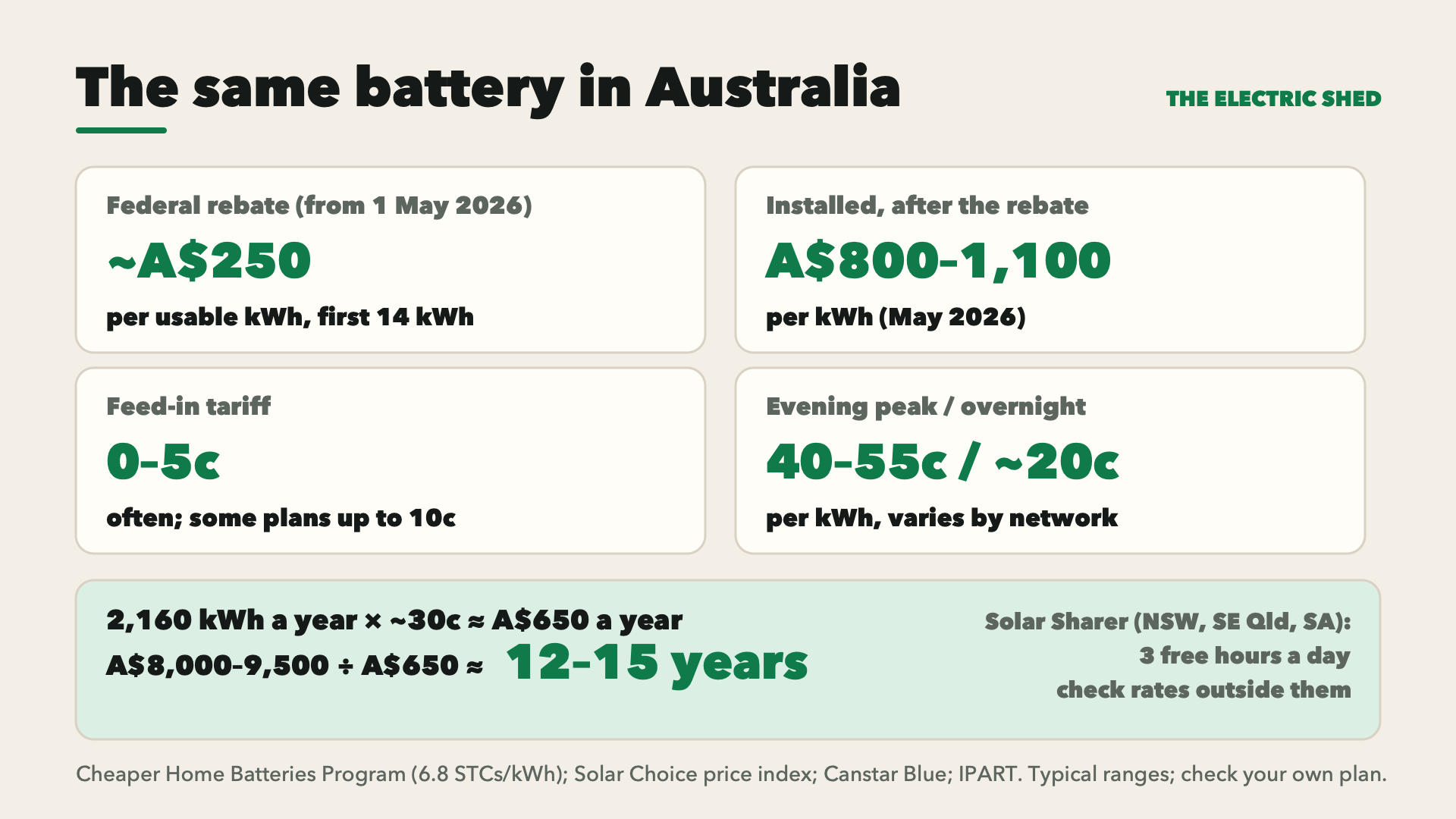
- The rebate. The federal Cheaper Home Batteries Program has been worth roughly A$250 per usable kWh since 1 May 2026 (6.8 STCs per kWh for the first 14 kWh) and steps down every six months to 2030 (Energy Matters, CHOICE). On a battery our size, that's a bit over A$2,000 off. Installed prices after the rebate are around A$800–1,100 per kWh (Solar Choice index, via Voltx).
- What a stored kWh is worth. Feed-in tariffs are often under 5c now (IPART benchmarks, via Energy Matters), evening peaks 40–55c, overnight around 20c (Canstar Blue). A battery covering your evening and night, like ours, averages something like 30c a kWh: roughly double ours.
- The sum: 2,160 kWh × 30c ≈ A$650 a year. On A$8,000–9,500 after the rebate, that's roughly 12–15 years, nearer 10 if most of it goes into the evening peak.
- Solar Sharer. Since 1 July 2026, NSW, South-East Queensland and South Australia have plans with three free hours of grid power in the middle of the day (energy.gov.au, CHOICE). A battery can fill for free on a cloudy day and run your evening. Check the rates outside those hours, which can be higher.
And in the UK
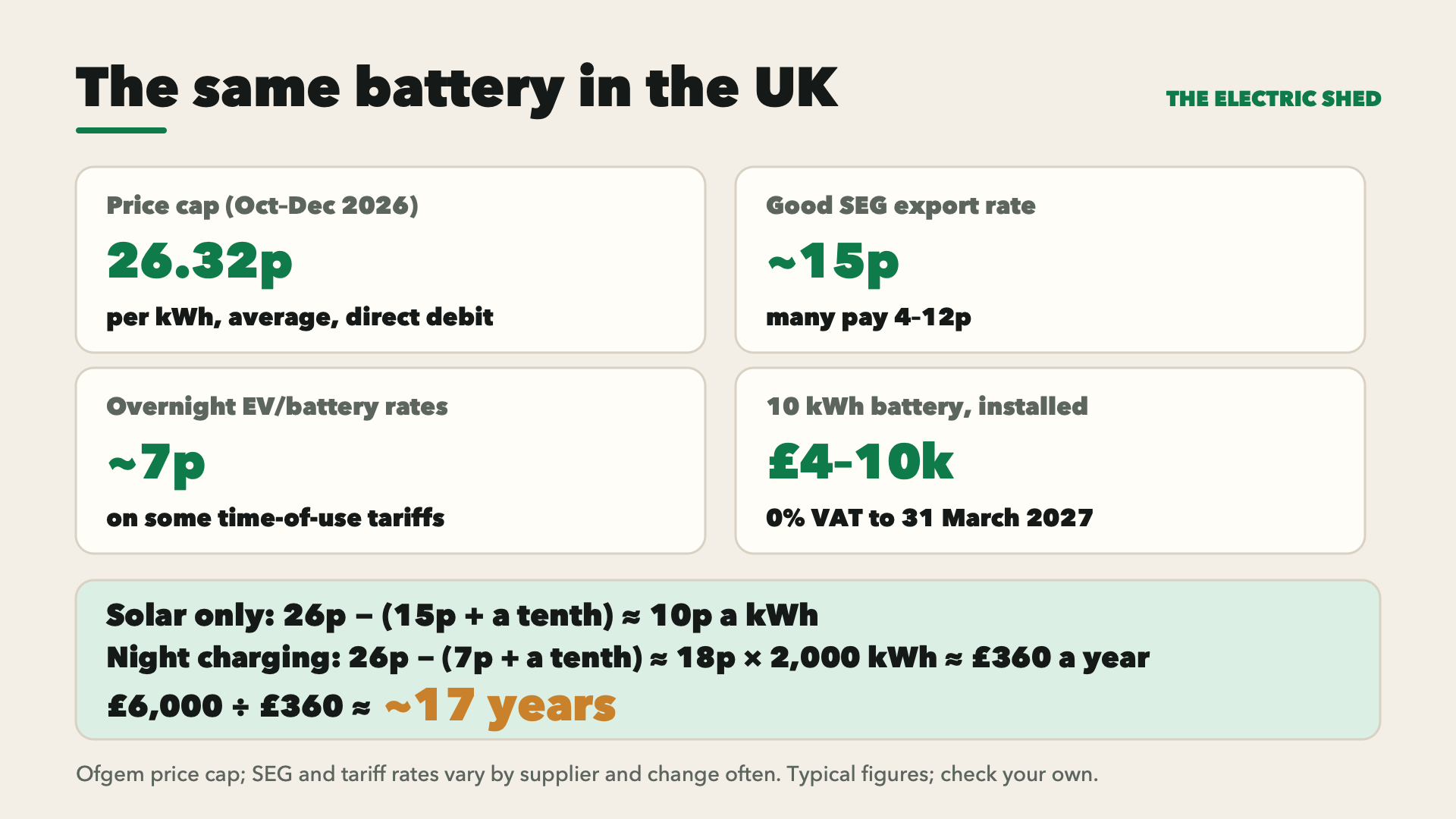
- Solar only: under the October 2026 price cap, electricity averages 26.32p per kWh (Ofgem). A good Smart Export Guarantee rate is around 15p (EnergyPlus). 26p − (15p + a tenth) ≈ 10p per stored kWh: our New Zealand problem again.
- Overnight charging: some time-of-use tariffs have night rates around 7p. Charge at 7p, use at 26p: about 18p per kWh, and it works in winter too.
- The sum: 2,000 kWh × 18p ≈ £360 a year. On a £6,000 battery, about 17 years. A cheaper battery, or a tariff that pays more for evening exports, brings that down. Batteries are zero-rated for VAT until 31 March 2027.
In the UK, the tariff you choose matters as much as the battery.
What a battery buys besides savings
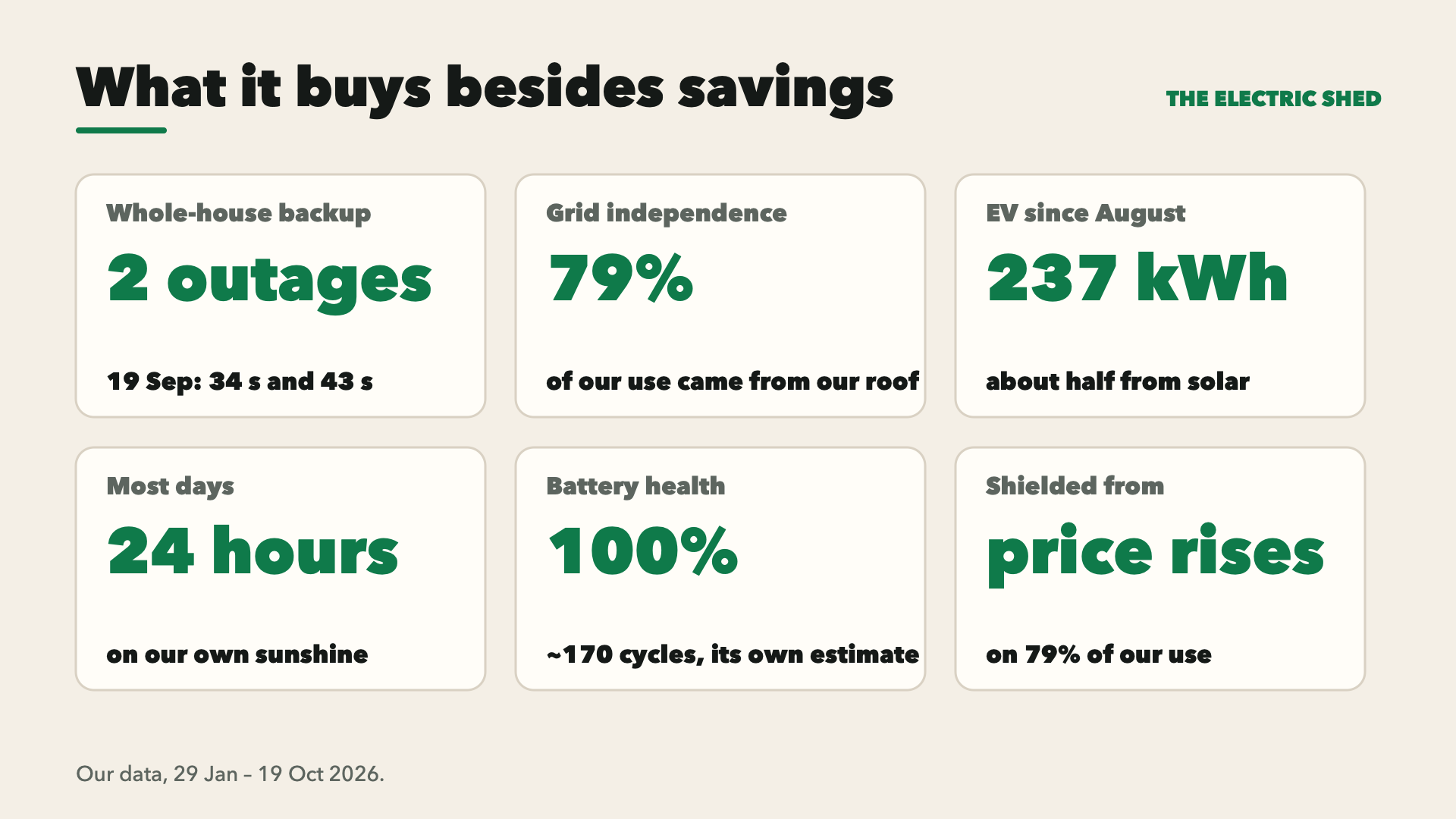
- Backup. Our system backs up the whole house. On 19 September the grid dropped out twice, for 34 and 43 seconds, and both times the house switched to the battery. In a long outage after a storm, it matters much more. Not every battery is installed with backup, so if you want it, ask.
- Independence. 79% of everything we used came from our own roof, so price rises hit us a lot less.
- A feeling the spreadsheet doesn't show. Most days the house runs around the clock on sunshine: from the roof in the day and from the battery at night. Watching the grid sit at zero all evening is quietly satisfying.
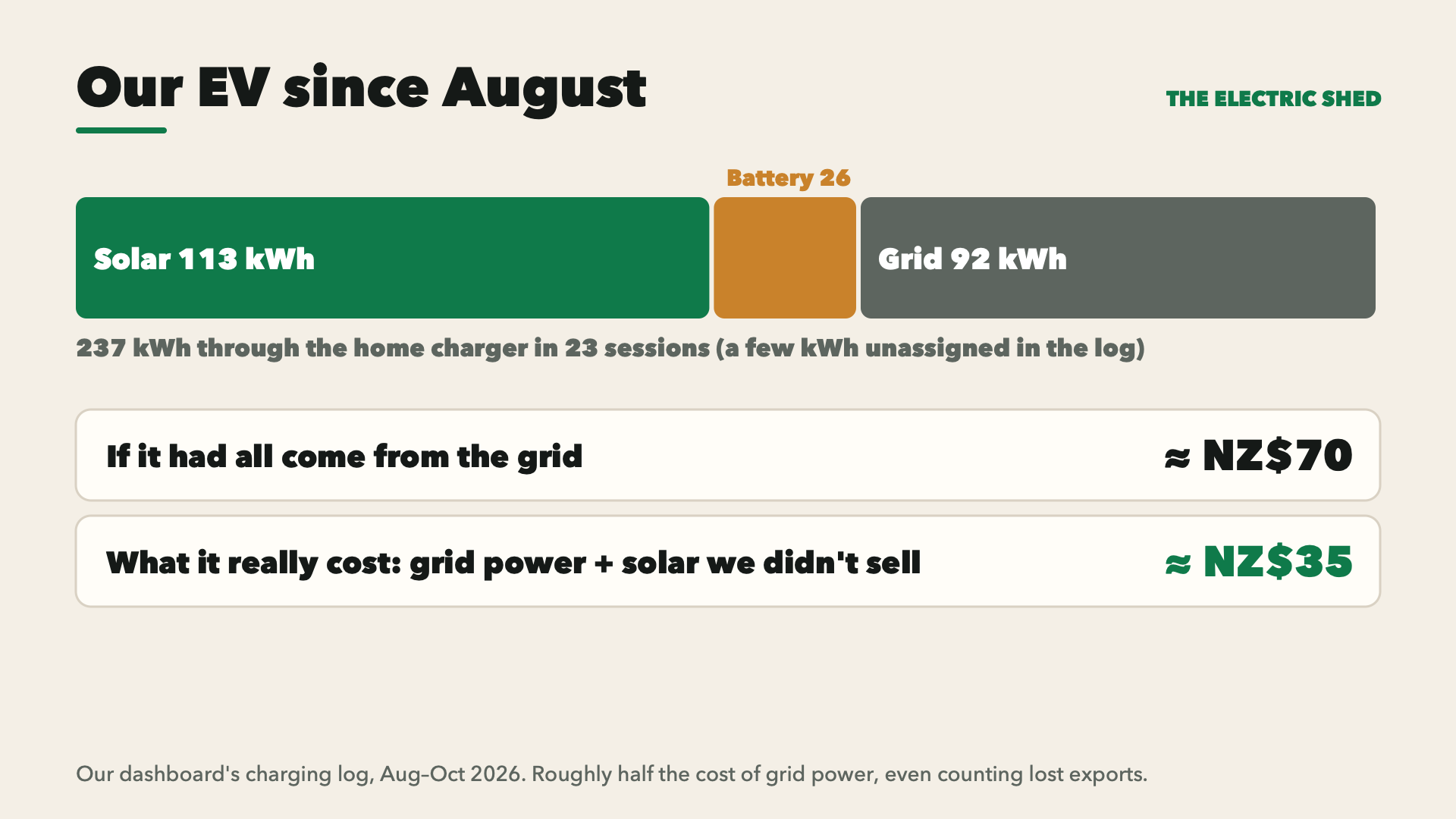
- The car. Since August, the home charger has put 237 kWh into our electric car: 113 kWh from solar, 26 from the battery and 92 from the grid. Counting the export income given up on that solar, it cost about NZ$35, against about NZ$70 from the grid. More in our GWM Ora 5 review, and on Sweet Commute: charged by the sun.
Battery now, or later?
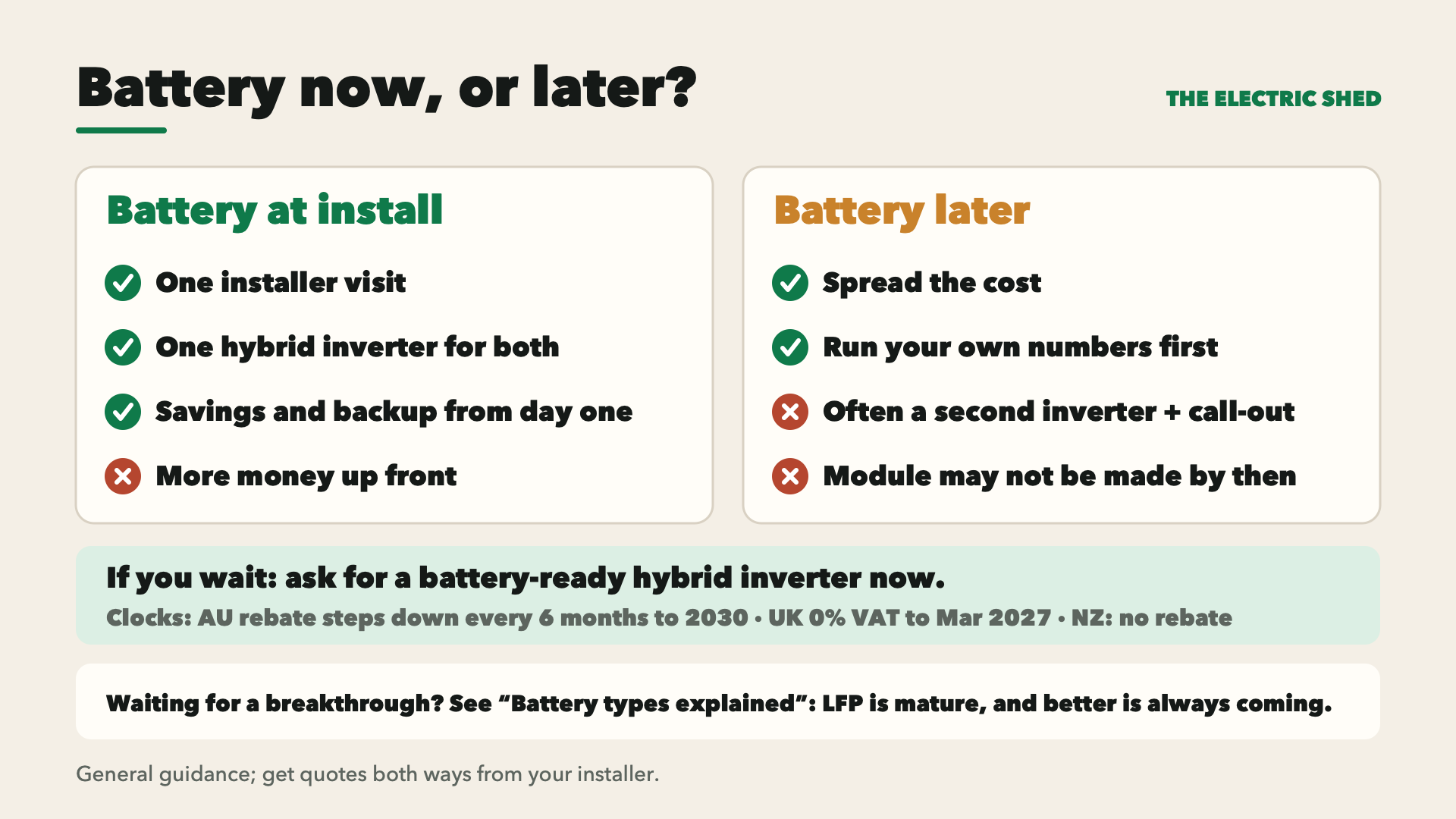
- At install is usually cheaper overall: one installer visit, one lot of switchboard work, and one hybrid inverter that runs both the panels and the battery. Adding a battery later to an ordinary solar inverter often means a second inverter, or a new one, plus another call-out.
- If you wait, ask for a battery-ready hybrid inverter now, and check the battery you'd want will work with it. Modular systems like ours let you add modules later, but check how long the maker plans to keep making them.
- Timing: Australia's rebate steps down every six months until 2030; UK 0% VAT on batteries runs to March 2027; New Zealand has no rebate, so the only clock is your power bill.
- Waiting for a breakthrough? LFP is mature and lasts thousands of cycles, and the next big thing has been a few years away for about 15 years. More in battery types explained.
Warranty small print
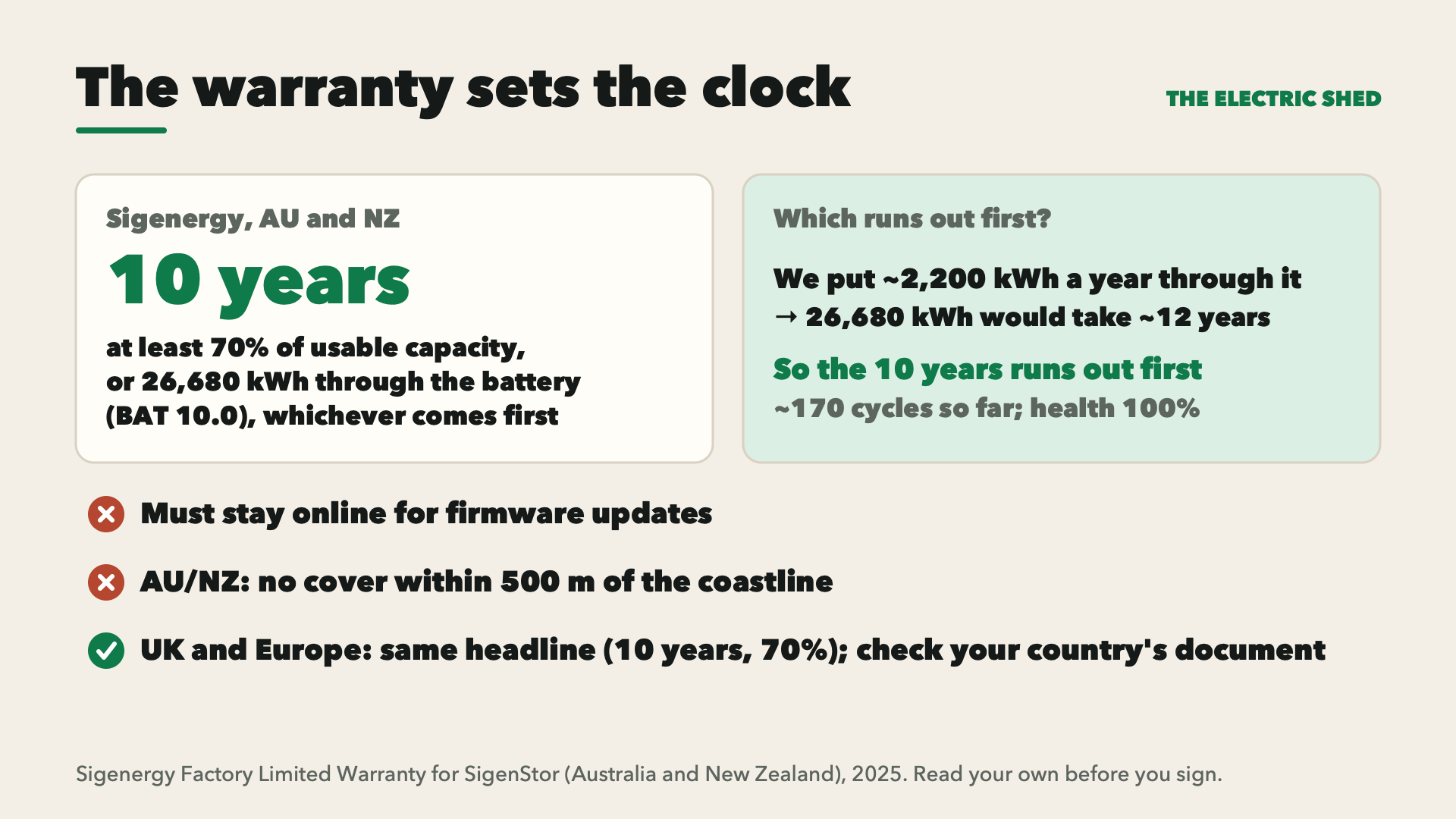
Sigenergy's warranty for Australia and New Zealand is 10 years, with at least 70% of usable capacity, or 26.68 MWh through our BAT 10.0 module, whichever comes first. At about 2,200 kWh a year, the 10 years runs out first. Two catches: the system has to stay online for firmware updates, and installs within 500 m of the coastline aren't covered in AU/NZ. The UK and European terms have the same headline, but check the document for your country.
After about 170 full cycles, at 90% round-trip efficiency, the battery's own health reading still says 100%. A battery doesn't fall off a cliff when its warranty ends, but payback after the warranty is a bet, not a guarantee.
So, is it worth it?
For us, in New Zealand, after nine months: the solar, clearly yes. The battery, on bill savings alone, not yet: somewhere between NZ$300 and NZ$700 a year depending on how you count it, and more as prices rise. We'd still buy it again. The system as a whole pays for itself, and the battery turns that into a house that runs on its own sunshine most of the year and keeps the lights on when the grid goes down.
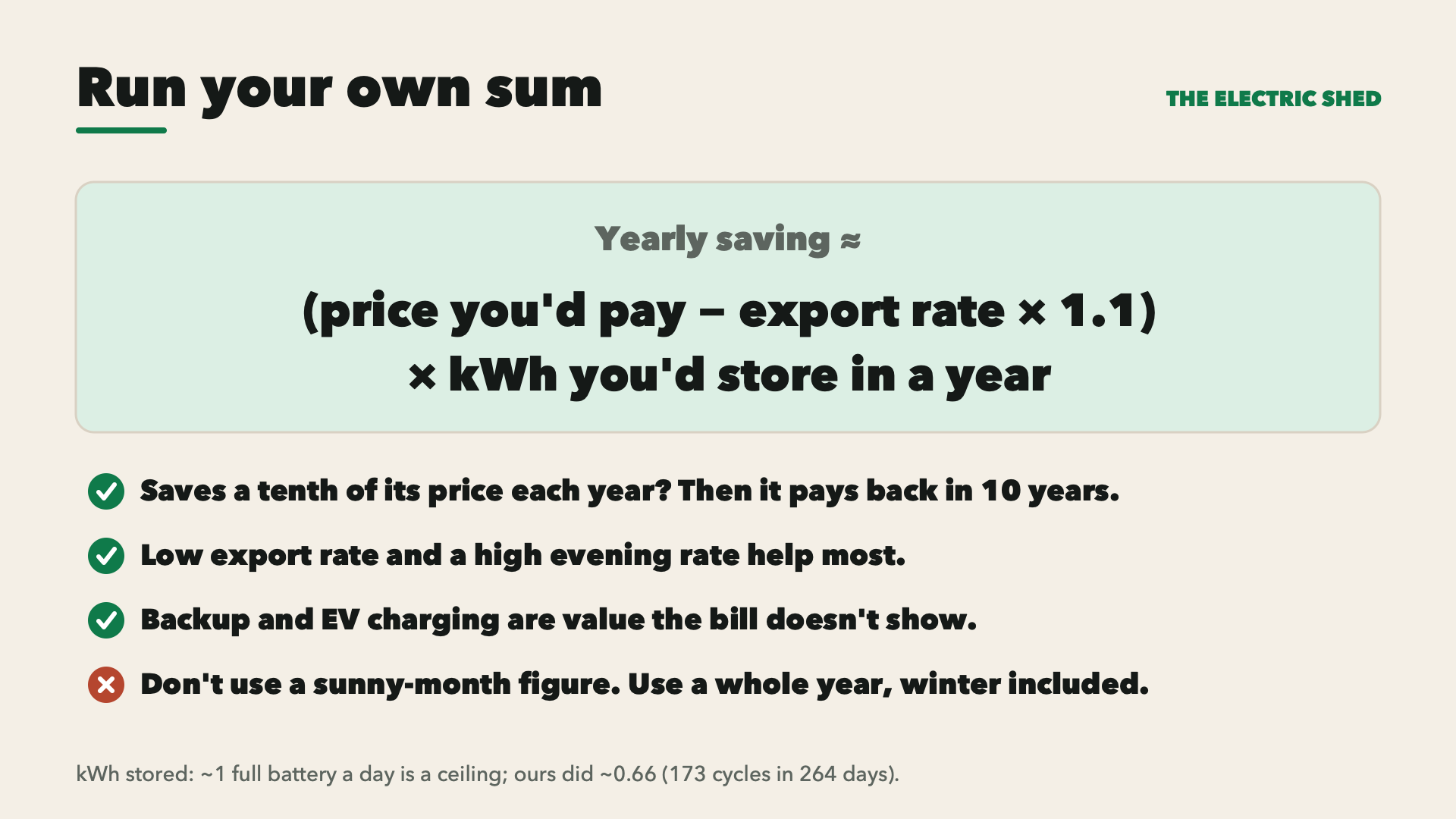
Run your own sum: (the price you'd otherwise pay − your export rate × 1.1) × the kWh you'd store in a year. If that comes to more than a tenth of the battery's price, it pays back inside a 10-year warranty. Our guide to working out a battery's payback goes through it step by step, and how to read your electricity bill shows where to find your rates.
Tell us your peak rate and export rate in the comments under the video, and we'll work out what a stored kWh is worth to you. Next instalment: one year, with a full summer, a proper look at winter, and whether a smaller battery would have done the job.
Sources
- Our own data (New Zealand): Sigenergy app (Feb–Aug 2026) and our own dashboard (Sep–Oct 2026), 29 January to 19 October 2026; battery value and peak-period figures from second-by-second samples, 18 September to 19 October 2026.
- MySolarQuotes NZ, solar payback 2026 data: median solar-only and solar-plus-battery prices.
- SolarQuotes, 6 kW and 6.6 kW system prices; Heatable, UK solar panel costs.
- Sigenergy, Factory Limited Warranty for SigenStor (Australia and New Zealand), 2025: 10 years, 70%, BAT 10.0 usable 8.76 kWh and 26.68 MWh, internet and coastal conditions.
- Electricity Authority: NZ power prices up 6.8% in the first half of 2026; Consumer NZ: about 12% in 2025.
- Energy Matters and CHOICE: Cheaper Home Batteries Program changes from 1 May 2026.
- Solar Choice Battery Price Index (May 2026), via Voltx: installed battery prices after the rebate.
- Canstar Blue (May 2026): electricity rates by network; IPART 2026–27 feed-in benchmarks, via Energy Matters.
- energy.gov.au and CHOICE: the Solar Sharer Offer.
- Ofgem, price cap unit rates: 26.32p/kWh, 1 October to 31 December 2026; EnergyPlus: SEG export rates.
- HMRC: 0% VAT on energy-saving materials, including batteries, to 31 March 2027.
Diagrams and app screenshots: The Electric Shed (the app is a free tool being built by the creators of this channel, coming to GitHub). Other photos: Wikimedia Commons, credited under each image.