Your electric car already has a charger inside it, so what is the box on the wall for? This guide follows the power from your roof to your car, and compares Sigenergy's two home chargers. We use the DC one, a 12.5 kW module, so that side is real owner data from New Zealand. We have not used the AC charger, so its side is researched from Sigenergy's datasheet, SolarQuotes and retailers, and labelled that way.
The short version
- kW is the tap, kWh is the bucket. A bigger tap fills the bucket faster, until something else limits it.
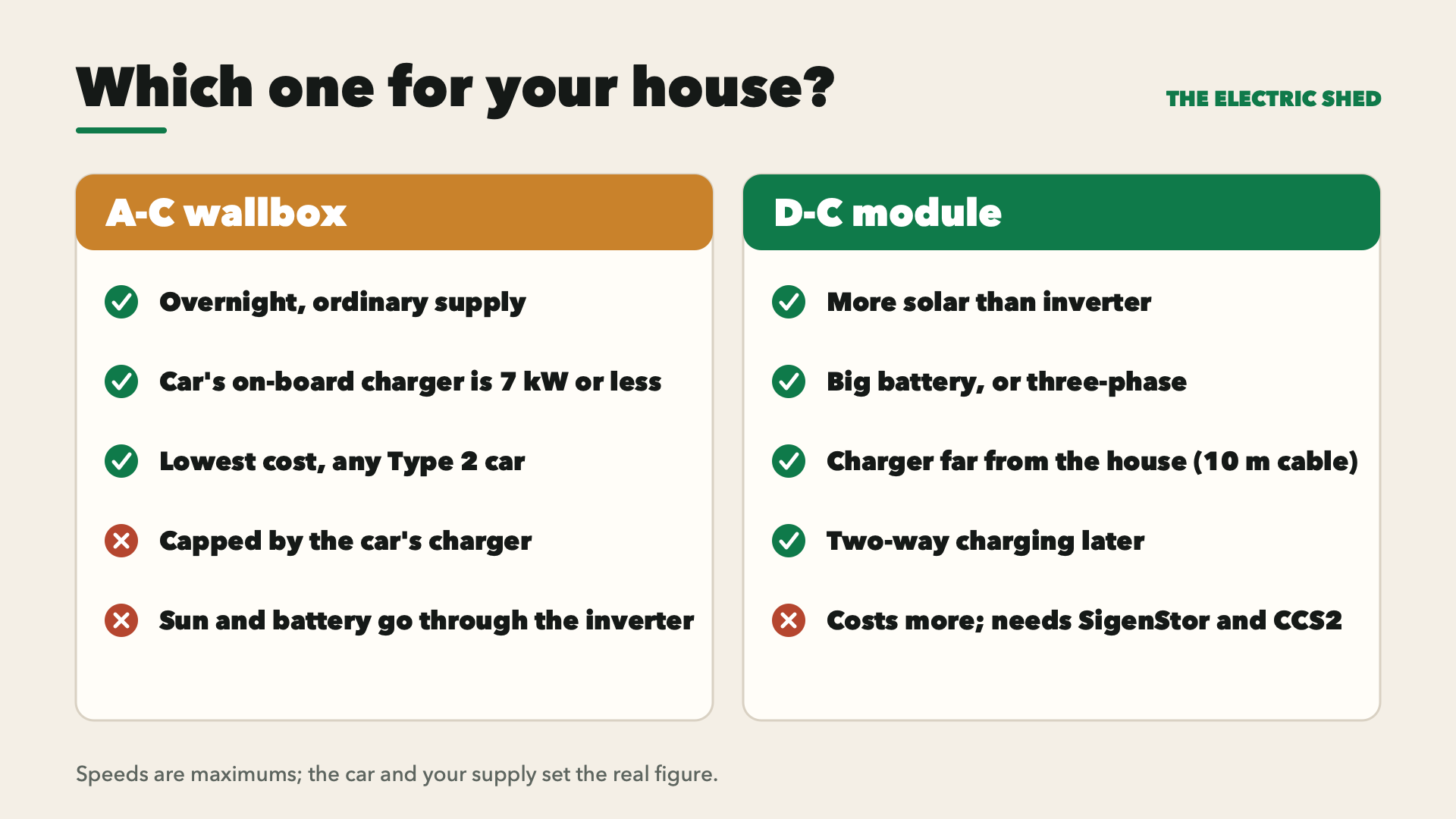
- An AC wallbox converts nothing. It's a smart, safe switch. The car's on-board charger turns AC into DC, and that sets your speed: usually 7–11 kW, 6.6 kW in our GWM Ora 5, however big the wallbox.
- A DC charger does the converting itself, so the power goes around the on-board charger straight into the battery.
- One hour of charging: about 40 km from a 7 kW AC charger, about 75 km from our 12.5 kW DC module (kW ÷ 0.17 kWh per km, best case).
- For most homes AC does the job. Look at DC for more solar than inverter, a big battery or three-phase, a long cable run, or two-way charging later.
From roof to lamp
Panels make DC power. It flows to the SigenStor, which is a battery and an inverter in one. The inverter turns DC into AC for the lamp and the TV, and spare power fills the battery. After sunset the battery runs the house. If the grid goes down, the gateway can switch to backup, if your system is wired for it.
AC charging: the car converts
An AC wallbox hands AC power to the car. The on-board charger turns it back into DC for the battery, losing some energy as heat. Typical on-board chargers are 7–11 kW; a few take 22 kW. In our Ora 5 it's 6.6 kW, so a 22 kW wallbox would still give us 6.6 kW.
DC charging: straight to the battery
Sigenergy's DC module feeds solar and battery power straight in. Ours is 12.5 kW, and a paid software licence unlocks 25 kW. It's two-way hardware, so a compatible car could run the house, if the car and your network allow it. Our Ora 5 can power appliances (V2L) but not the house, so we don't count on that. The module can only pass on what your solar, battery and inverter give it: in five weeks ours has never gone above 11.1 kW. Our full DC charger review has every number.
What the AC charger needs (researched, not tested)
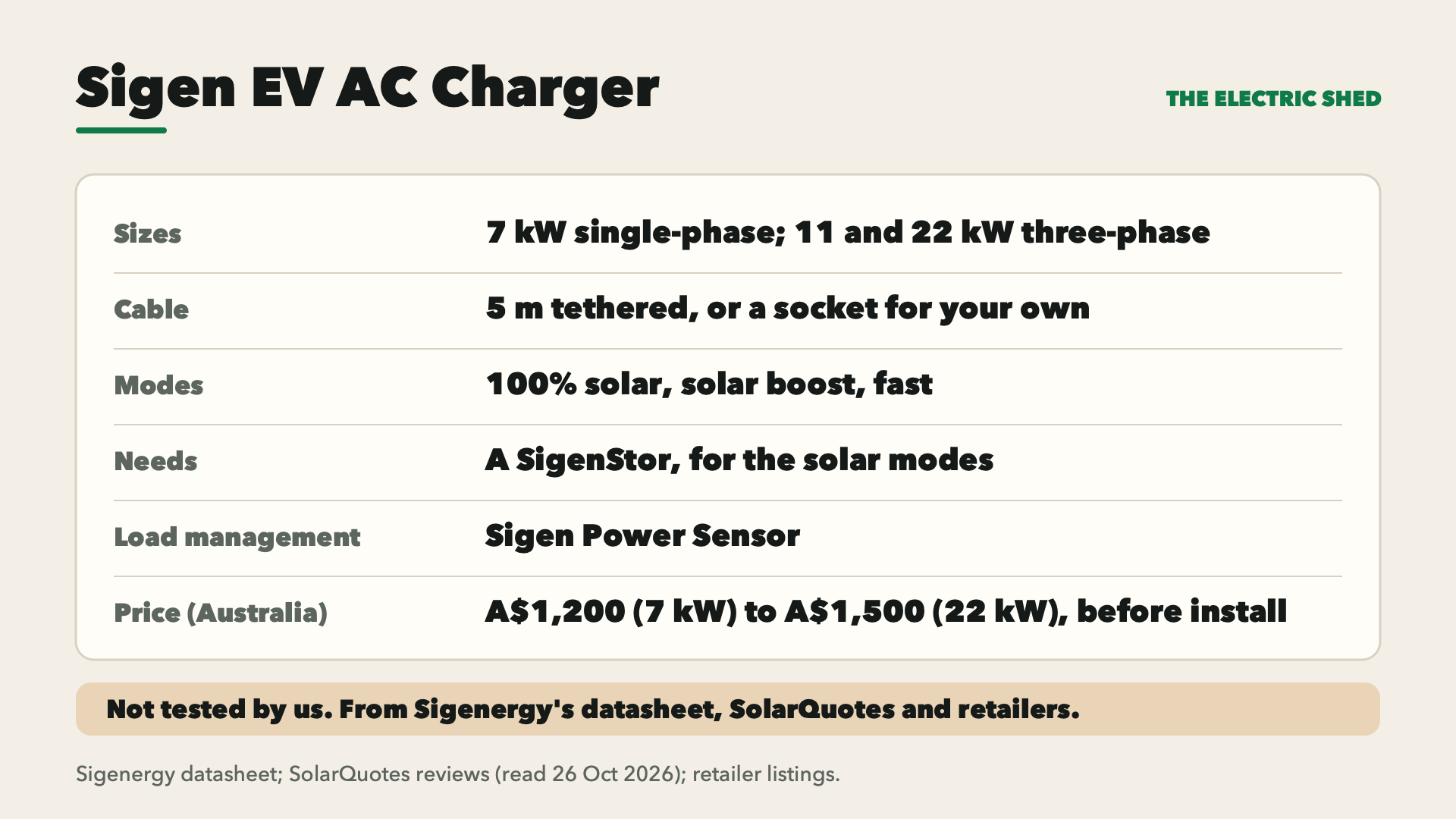
- Sizes: 7 kW single-phase; 11 and 22 kW three-phase. A 5 m tethered cable, or a socket for your own.
- Modes: 100% solar, solar boost and fast. SolarQuotes says these need a SigenStor battery system; one retailer lists solar-surplus charging with a power sensor on other inverters. Check with your installer.
- Load management: needs the Sigen Power Sensor, to stop the charger overloading your supply.
- Price: about A$1,200 (7 kW), A$1,300 (11 kW) and A$1,500 (22 kW) in Australia (SolarQuotes, October 2026), before installation. We found no New Zealand price.
- Owner reports: mostly positive. SolarQuotes lists issues with switching between single- and three-phase, phone support for commissioning on existing sites, and solar surplus charging not working when an external export limit is applied.
Which one for your house?
AC if you charge overnight on an ordinary supply and your car's on-board charger is 7 kW or less. DC if you have more solar than inverter, a big battery or three-phase, the charger has to sit a long way from the house (the DC cable is fixed, 7.5 or 10 m), or you want two-way charging later. Either way, set it up in the app: the charging mode, a cut-off for how low the house battery can go for the car, and a schedule.
For the EV side of this, Sweet Commute has a shorter version: A DC charger at home.
Sources
- Sigenergy, Sigen EV AC Charger datasheet (via SolarQuotes): modes, load management, mySigen app, IP65, OCPP.
- SolarQuotes, Sigenergy EV charger reviews: AC prices, owner reports, DC upgrade by paid software unlock, warranty (read 26 October 2026).
- Retailer listings (qualityheating.co.uk, estg.eu, Krannich Solar): Sigen EV AC Charger sizes and specs.
- Sigenergy, Sigen EV DC Charging Module datasheet; PSW Energy notes on the 12.5 to 25 kW licence.
- Trade Me, Powering up at home: a straight-up guide to EV charger costs: NZ wall charger and install costs, for context.
- Our own data: the channel's dashboard, reading our Sigenergy system, 12 September – 18 October 2026, New Zealand.
Diagrams: The Electric Shed.